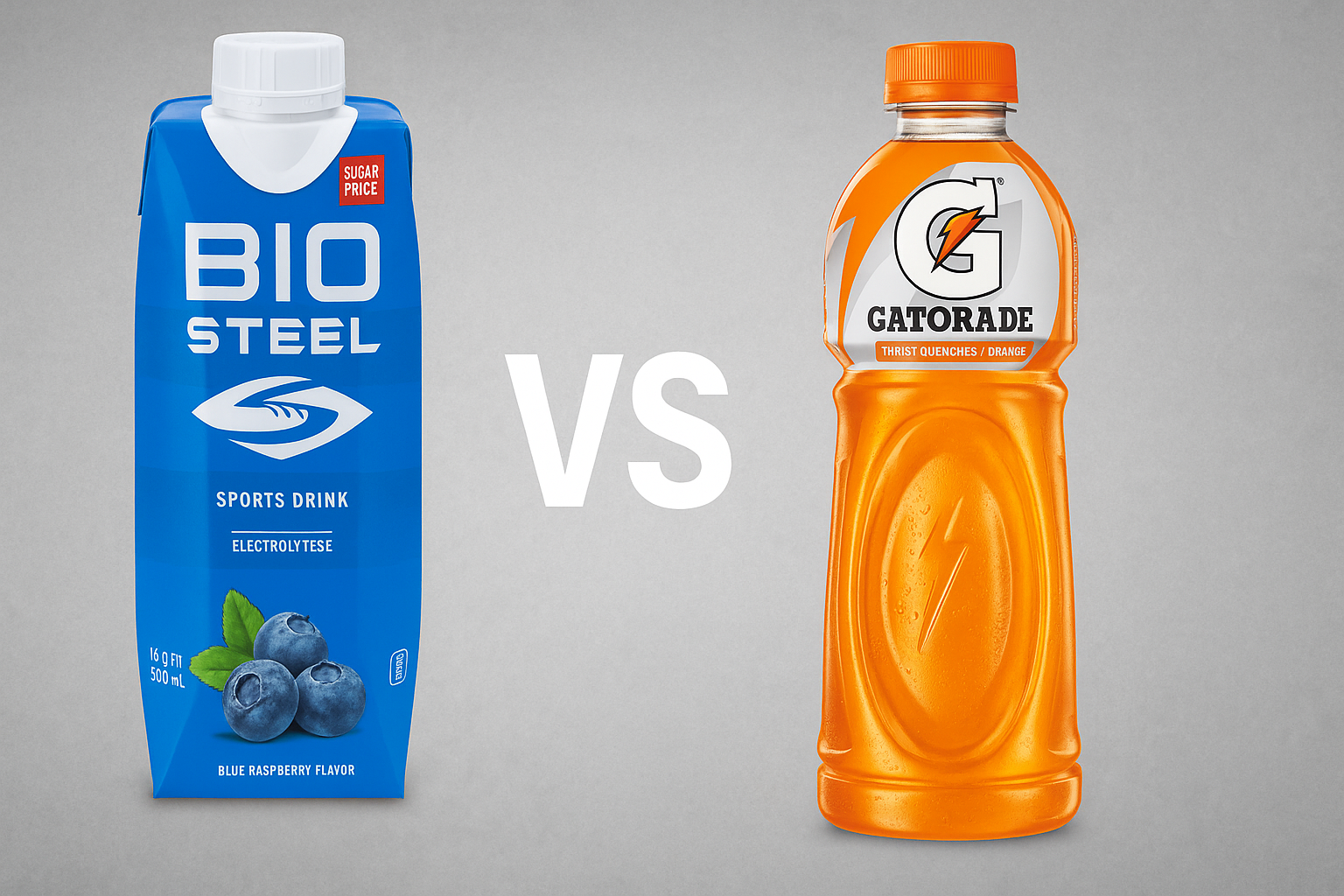
You’ve just wrapped up your workout, you’re a little sweaty, a little tired, and you’re heading to the drinks aisle: which bottle do you reach for? That’s the question facing many athletes, gym-goers and active people today when choosing between BioSteel Sports Drink and Gatorade Sports Drink. Both promise hydration and recovery, but their formulas, target audiences and flavour options differ quite a bit.
In this article I’ll walk you through what each brand brings to the table — from ingredients to taste to real-world use-cases — so you can make a smarter choice based on you.
The Brands at a Glance
Gatorade – the classic hydration choice
Gatorade has long been the go-to in sports hydration, with wide availability and decades of brand recognition. It’s built around the idea of replacing what you sweat out: fluid, salts (electrolytes) and energy (carbs).
BioSteel – the “cleaner” sports drink option
By contrast, BioSteel positions itself more toward the health- and fitness-conscious consumer. It emphasises low or zero sugar, “cleaner” ingredients (like stevia rather than traditional sugar in some varieties) and added nutrients such as amino acids and vitamins.
Ingredient & Nutrition Comparison
Sugar, sweeteners & calories
- BioSteel offers versions with very low sugar or zero sugar, using sweeteners like stevia. For example, the “Sports Drink / Blue Raspberry” variant lists only 10 calories and 1 g carb.
- Gatorade’s more classic formulas use traditional sugar (sucrose/dextrose) in many regions, delivering carbs for energy during high-intensity or prolonged activity. The takeaway: If you’re avoiding sugar, watching calories or training in a moderate way, BioSteel has the edge. If you’re in heavy training or endurance mode, the extra carbs in Gatorade may serve you better.
Electrolytes and key minerals
- BioSteel’s “Hydration Mix / Mixed Berry” shows a “Mineral Blend” including calcium, magnesium, potassium and sodium (via sodium chloride).
- Gatorade is built on sodium and potassium replacement (classic for sweat loss) and offers specialised lines like Gatorlyte for even higher electrolyte loads.
The takeaway: If you’re sweating heavily (long sessions, heat/humidity, team sport), you’ll want a product with higher sodium/potassium. BioSteel may be fine for lighter sessions but check the electrolyte load.
Additional nutrients (vitamins, amino acids, etc.)
- BioSteel adds in amino acids (like leucine, isoleucine, valine) and vitamins/minerals in some product lines.
- Gatorade focuses primarily on hydration+energy+electrolytes; secondary nutrients exist but they’re not always the headline.
The takeaway: If your goal includes muscle recovery in addition to hydration (e.g., weight training, multiple sessions a day), BioSteel’s “extras” might be beneficial.
Artificial additives, colours, and clean-label considerations
- BioSteel markets itself on “cleaner label” criteria: natural flavours, fewer artificial dyes.
- Gatorade uses a broad array of flavours and colours; some product news indicates that the brand is working to phase out artificial dyes.
- The takeaway: If you’re sensitive to food additives or colours, or prefer minimalist ingredient lists, BioSteel may appeal more.
Flavor & Variety – What Your Taste and Situation Demand
BioSteel flavour line-up & best uses
BioSteel offers flavours such as Mixed Berry, Blue Raspberry, White Freeze, Rainbow Twist and more.
- Taste profile: For example, the Blue Raspberry sports drink lists only ~10 calories and uses stevia and sea salt in its electrolyte mix.
- Best uses: These lighter sugar, “clean taste” lines are ideal for moderate workouts, daily hydration, or when you’re calorie-conscious.
Example: If you’re doing a 45-minute gym session, then a flavour like White Freeze or Rainbow Twist from BioSteel gives you hydration without a heavy sugar load.
Gatorade flavour line-up & best uses
Gatorade has a vast range of flavours: Lemon-Lime, Orange, Fruit Punch, Cool Blue, Glacier Freeze, and many more.
- Taste profile: Bold fruit, sweet, sometimes “candy-like” but paired with the salt/metallic electrolyte edge. Some sugar-free versions (Gatorade Zero) exist too.
- Best uses: Long duration sports, team sports, hot/humid environments, occasions where flavour punch + quick carb + electrolyte reset matter.
Example: If you’re playing a 90-minute soccer match or training outdoors and sweating heavily, a classic Gatorade flavour like Fruit Punch or Glacier Freeze will provide both flavour and functional hydration.
How to pick a flavour/variant for your workout style
- If you’re calorie- or sugar-sensitive, lean toward BioSteel or Gatorade’s sugar-free variants.
- If you’re doing heavy sweat, long duration, high intensity, pick a Gatorade flavour/variant with more carbs and sodium.
- If you prefer clean taste / minimal sweet aftertaste, BioSteel may feel “lighter.”
- Flavour preference matters: if you enjoy very sweet, bold tastes, go classic Gatorade. If you prefer subtle, “refreshing” or “clean” flavour, BioSteel can be better.
- Consider availability and budget: some flavours/lines may cost more or be harder to get in certain regions (e.g., India, or non-North-America markets).
Performance & Use-Case Scenarios
When Gatorade makes sense
- Team sport, field/hockey/football, anything >60 minutes of high intensity.
- Hot/humid conditions where sodium losses are high.
- When you need carbs + electrolyte replacement fast (e.g., double-session day).
When BioSteel may be better
- Everyday gym workouts, weightlifting, moderate sessions (<60 minutes).
- Health- or diet-focused routines where you want hydration but minimal sugar/carb load.
- Recovery days where electrolyte support + amino acids matter more than large carb intake.
Practical considerations in real life
- Cost: Classic Gatorade is often cheaper and more widely available globally.
- Taste: If you don’t like super-sweet drinks, a lighter alternative like BioSteel may suit you better.
- Your body: Sweat rate, environment, duration matter. If you’re a “heavy sweater,” you may actually need more sodium than a “clean label” product supplies.
- Travel/accessibility: If you’re in a region where Gatorade is ubiquitous, it’s easier; if you’re in a market where BioSteel is less common, consider that.
Pros & Cons Summary
Gatorade Sports Drink
Pros:
- Proven formula for hydration + electrolytes + carbs
- Widely available across markets
- Huge flavour variety, lots of trial options
Cons: - Higher sugar/carb content (in many variants)
- May contain more artificial colours/flavours (though brand is making changes)
- If you’re only doing light activity or want low sugar, may be “overkill”
BioSteel Sports Drink
Pros:
- Low / zero sugar options; clean-label appeal
- Added nutrients like amino acids / minerals in some lines
- Lighter taste profiles — better suited for daily use or moderate training
Cons: - May provide less carbohydrate / lower sodium for heavy-sweating athletes
- Possibly higher cost or less availability in some countries
- If training intensely, might not offer same “burst” of energy/carb as classic sports drinks
Which One Should You Choose?
Here’s a simple decision guide:
- If you train intensely, sweat a lot, are outdoors in heat, or playing team/field sport → go with Gatorade or a high-electrolyte, high-carb sports drink.
- If you train moderately, indoors, weight-training or general fitness, and you care about sugar/carb intake or ingredient purity → BioSteel is likely the better fit.
- Don’t forget water: For light activity (30 mins or less, moderate effort), plain water may be totally sufficient — sports drinks are supplemental, not always required.
- Always match your choice to your workout style + environment + personal health goals. For example, someone with dietary restrictions, diabetic concerns, or trying to lose weight might lean toward the lower sugar option even if training is harder.
FAQs
Q: Is Gatorade bad because of sugar?
Not intrinsically. The sugar is there for a functional reason (carb replacement during intense activity). But if you’re not engaging in heavy exercise, the sugar may be more than needed and could contribute to excess calories.
Q: Can I drink BioSteel every day?
Yes — particularly the low/zero sugar varieties. For regular daily hydration or moderate workouts, it’s a fine choice. Just be aware of whether your electrolyte / sodium needs are being met if you’re in very hot conditions or heavy sweat sessions.
Q: Do I need amino acids in my sports drink?
It depends. If you’re doing muscle-driven training, heavy load, recovery focus, added amino acids can help. But for many general fitness routines, hydration and electrolytes are likely the priority.
Q: Are these drinks safe for kids/teens?
Generally yes in moderation — but watch sugar content (especially with classic sports drinks) and overall diet. For kids doing light activity, water + balanced snack may suffice more often than a sports drink.
Q: What about hydration for non-athletes?
If your activity is light (walking, casual gym, day-to-day movement), you likely don’t need a sports drink. Good hydration comes from water + balanced meals. Sports drinks are more for when you’re sweating heavily or working out long/hard.
Conclusion
So which is “right”? The honest answer: both have their place. If you prioritise cleaner ingredients, low sugar and moderate training volumes, BioSteel offers a compelling alternative. If you’re out there pushing hard, sweating buckets, needing carb + electrolyte fast – Gatorade still holds strong.
The key is to match the drink to your workout type, environment, diet and goals. Whichever you choose, don’t forget: hydration starts with water, and a sports drink doesn’t replace smart nutrition, rest or training. Use it as a tool — not a crutch.