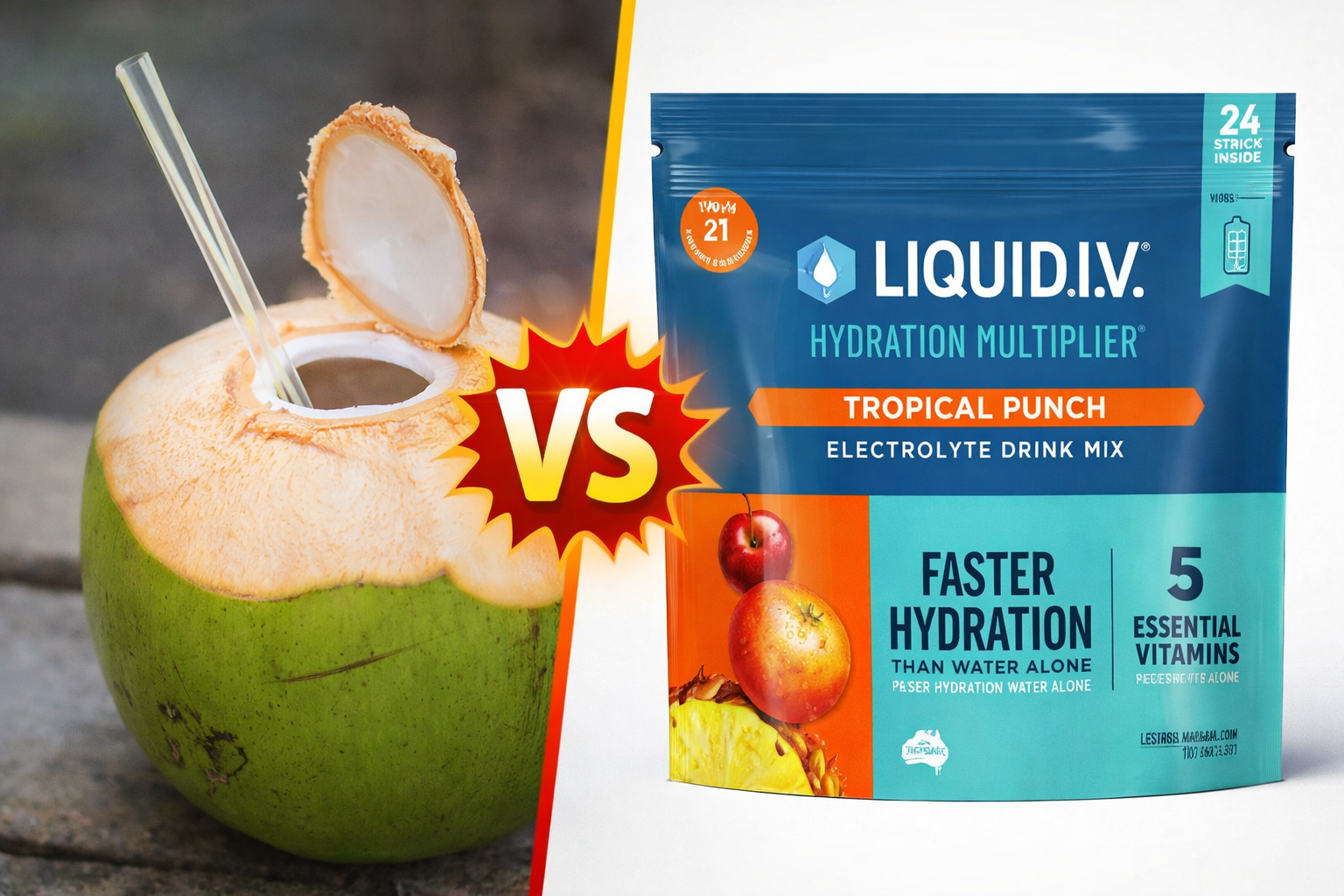
We are living through a hydration renaissance. Gone are the days when staying hydrated simply meant carrying around a plastic bottle of tap water. Now, hydration is functional. It promises better skin, more energy, faster recovery, and improved athletic performance.
Walk down the beverage aisle of any grocery store, and you will see shelves dominated by two major players in this space: the natural heavyweight, coconut water, and the scientifically engineered challenger, Liquid I.V.
Both products promise to hydrate you faster and more efficiently than water alone. Both boast devoted followings, from yoga instructors swearing by the tropical fruit juice to marathon runners ripping open powder sticks at mile 20. But they achieve their goals in radically different ways. One relies on a nutrient profile perfected by nature over millions of years, while the other utilizes a specific ratio of ingredients developed in a lab to hack your body’s absorption rates.
So, which one deserves a spot in your gym bag? Is the high sodium content in Liquid I.V. a dealbreaker? Is coconut water enough to save you from a hangover? This guide breaks down the science, the nutrition, and the practicality of both to help you decide.
What is Coconut Water?
Often dubbed “Mother Nature’s sports drink,” coconut water is the clear liquid found inside young, green coconuts. It is distinct from coconut milk, which is made from grating the meat of mature coconuts. For centuries, tropical cultures have used it not just as a refreshing beverage, but as a health tonic.
The Natural Nutrient Profile
The primary appeal of coconut water is its impressive electrolyte composition, specifically potassium. A single cup of coconut water can contain more potassium than a banana. This mineral is vital for preventing muscle cramps and maintaining proper fluid balance in the body.
Because it is a juice, it also contains natural carbohydrates in the form of sugar, along with small amounts of sodium, calcium, and magnesium. It is generally low in calories and fat-free.
Sourcing and Processing
Not all coconut water is created equal. The highest quality versions are cold-pressed and never heated, preserving the delicate enzymes and nutrients. However, many shelf-stable versions found in supermarkets are pasteurized (heated to kill bacteria), which can alter the nutrient profile and taste. Some brands also add fruit juice or extra sugar to standardise the flavor, so reading the label is essential.
What is Liquid I.V.?
Liquid I.V. is not a beverage you buy in a bottle; it is a hydration multiplier powder mix. The brand has exploded in popularity, marketing itself as a solution that can hydrate you two to three times faster than water alone.
Cellular Transport Technology (CTT)
The core of Liquid I.V.’s marketing and effectiveness lies in what they call Cellular Transport Technology (CTT). While it sounds like futuristic jargon, it is actually based on the World Health Organization’s guidelines for Oral Rehydration Solutions (ORS).
CTT utilizes a precise ratio of sodium, glucose (sugar), and potassium. When these three nutrients are consumed together in water, they create an osmotic force that allows water to be absorbed into the bloodstream earlier on in the digestive system. essentially, it opens a “fast lane” for water to enter your body, bypassing the slower, standard digestion process.
The Ingredients
Unlike the single-ingredient profile of pure coconut water, Liquid I.V. is a formulated blend. The primary ingredients are usually pure cane sugar (for the glucose needed for CTT), dextrose, citric acid, salt, sodium citrate, and dipotassium phosphate. It is also fortified with B vitamins (B3, B5, B6, B12) and Vitamin C.
Nutritional Breakdown: A Side-by-Side Comparison
To truly understand which option is better for you, we need to look at the numbers. Let’s compare a standard 16oz serving of unsweetened coconut water against one stick of Liquid I.V. mixed into 16oz of water.
Calories and Sugar
- Coconut Water: Approximately 40–60 calories and 9–12 grams of sugar. The sugar in pure coconut water occurs naturally (fructose and glucose).
- Liquid I.V.: 45 calories and 11 grams of sugar. The sugar here is added cane sugar and dextrose.
The Verdict: They are nearly identical in caloric density and sugar content. However, the purpose of the sugar differs. In coconut water, it is simply part of the fruit. In Liquid I.V., the sugar is functional; it is required to activate the active transport mechanism that pulls water into your cells. If you are strictly avoiding added sugars, coconut water wins. If you view sugar as a fuel source and hydration vehicle, Liquid I.V. makes a strong case.
Sodium Content
- Coconut Water: Low sodium, typically around 40–60mg per serving (though varies by brand).
- Liquid I.V.: High sodium, typically 500mg per stick.
The Verdict: This is the biggest differentiator. Liquid I.V. has roughly 10 times the sodium of coconut water. For the average sedentary person, 500mg is a significant chunk of your daily recommended intake. However, for an athlete losing salt through sweat, the low sodium in coconut water might not be enough to replenish what is lost.
Essential Minerals (Potassium & Magnesium)
- Coconut Water: High potassium (around 400–600mg) and contains magnesium (up to 60mg).
- Liquid I.V.: Moderate potassium (around 370mg) and no significant magnesium.
The Verdict: Coconut water is the potassium king. If your diet is high in sodium (like most modern diets) and low in fresh produce, the extra potassium in coconut water helps counterbalance salt intake and lower blood pressure.
Vitamins
- Coconut Water: Contains small amounts of Vitamin C naturally.
- Liquid I.V.: Fortified to contain significantly more Vitamin C and B vitamins than coconut water.
The Verdict: Liquid I.V. acts more like a supplement here, injecting vitamins that aren’t naturally present in water.
Hydration Efficiency: The Science of Speed
When you drink water, it doesn’t immediately hydrate you. It has to pass through the stomach and be absorbed in the small intestine. The speed of this absorption depends on the osmolality (concentration) of the fluid.
Liquid I.V. and the Sodium-Glucose Pump
Liquid I.V. is designed to be hypotonic or isotonic depending on the mixture, but its superpower is the sodium-glucose cotransport system. The body uses sodium and glucose molecules as “chaperones” to carry water across the intestinal wall rapidly. This makes it exceptionally effective for acute dehydration. If you are feeling dizzy, parched, or are in the middle of intense exertion, Liquid I.V. forces hydration into your system quickly.
Coconut Water and Volume Replacement
Coconut water is naturally isotonic, meaning it has a similar concentration of salts and sugars to the human body. Studies have shown that coconut water is as effective as plain water and commercial sports drinks for rehydration after moderate exercise. It causes less nausea and fullness than plain water, meaning people can drink more of it comfortably. However, because it lacks high sodium, it doesn’t trigger that same rapid “pump” mechanism that Liquid I.V. does. It hydrates you well, but perhaps not with the same immediate medical-grade speed.
Best Use Cases: When to Drink Which?
Because their nutritional profiles are so different, coconut water and Liquid I.V. serve different masters. They shouldn’t be seen as direct competitors, but rather as tools for different jobs.
Choose Coconut Water When:
- You want daily wellness: If you sit at a desk, go for light walks, or do yoga, coconut water is a fantastic, low-sodium way to stay hydrated and get a potassium boost.
- You have a high-sodium diet: The high potassium content helps flush out excess sodium from processed foods.
- You prefer whole foods: If your goal is to consume things that are as close to the earth as possible, pure coconut water is the clear winner.
- You want a refreshing treat: Sometimes you just want something that tastes good and isn’t plain water.
Choose Liquid I.V. When:
- You are doing high-intensity cardio: If you are running for more than an hour or sweating profusely (HIIT, spin class), you are losing salt. You need the 500mg of sodium in Liquid I.V. to replace it.
- You are hungover: Alcohol is a diuretic. The morning after a night out, you are acutely dehydrated. The rapid absorption technology of Liquid I.V. will make you feel human again faster than sipping coconut water.
- You are traveling: Flying is incredibly dehydrating due to the low humidity in cabin air.
- You are sick: If you have the flu or food poisoning, you are losing fluids rapidly. Liquid I.V. mimics the oral rehydration solutions used in hospitals.
Taste and Convenience
We cannot ignore the practicalities. The best hydration drink is the one you will actually drink.
Flavor Profiles
Coconut water is polarizing. It has a distinct, nutty, slightly sweet, and sometimes savory flavor profile. Some brands taste crisp and clean (usually the pink ones), while others can taste oddly thick or processed. If you hate the taste of coconut, there is no masking it.
Liquid I.V. comes in a variety of fruit flavors like Lemon Lime, Passion Fruit, Strawberry, and Watermelon. Because of the high salt content, there is a distinct “saline” undertone to the sweetness. It tastes like a thicker, saltier Gatorade. It is generally very sweet, which appeals to many but can be cloying to others.
Portability and Shelf Life
Liquid I.V. wins the convenience category hands down. The small stick packs fit in a pocket, purse, or gym bag. They are TSA-friendly and have a long shelf life. You can turn any bottle of tap water into a sports drink in seconds.
Coconut water is heavy. You are paying for the water weight when you buy it. Once opened, it must be refrigerated and consumed quickly (usually within 24-48 hours) or it will spoil.
Cost Analysis
If you plan on making one of these a daily habit, the cost adds up.
Coconut Water:
Depending on the brand and size, coconut water can be expensive.
- Premium (Harmless Harvest): ~$4.00 – $5.00 per bottle.
- Standard (Vita Coco/Zico): ~$2.00 – $3.00 per bottle.
- Bulk: Can get down to ~$1.50 per serving if buying large cartons.
Liquid I.V.:
- Single sticks: Usually sold in packs. A 16-pack typically retails for around $24.00.
- Price per serving: ~$1.50.
- Bulk: Costco or subscription models can bring this down closer to $1.00 per stick.
Liquid I.V. is generally more cost-effective per serving, especially compared to premium raw coconut water. It also produces significantly less plastic waste, as you aren’t buying a new plastic bottle for every drink.
Conclusion
The battle between coconut water and Liquid I.V. isn’t about one being “healthier” than the other; it is about matching the solution to the problem.
If you are looking for a medical-grade hydration tool to save you from intense dehydration, heat exhaustion, hangovers, or marathon training, Liquid I.V. is the superior choice. Its science-backed ratio of sodium and glucose drives water into your system with impressive speed.
However, if you are looking for a natural, nutrient-dense beverage to sip on during a workday or after a light yoga session, Coconut Water reigns supreme. It offers a massive hit of potassium without overloading your system with sodium you didn’t earn through sweat.
Ultimately, the best approach might be a hybrid one. Keep a few sticks of Liquid I.V. in your travel bag and medicine cabinet for emergencies and heavy workouts, but keep a bottle of cold coconut water in the fridge for those moments when you just want a taste of the tropics.