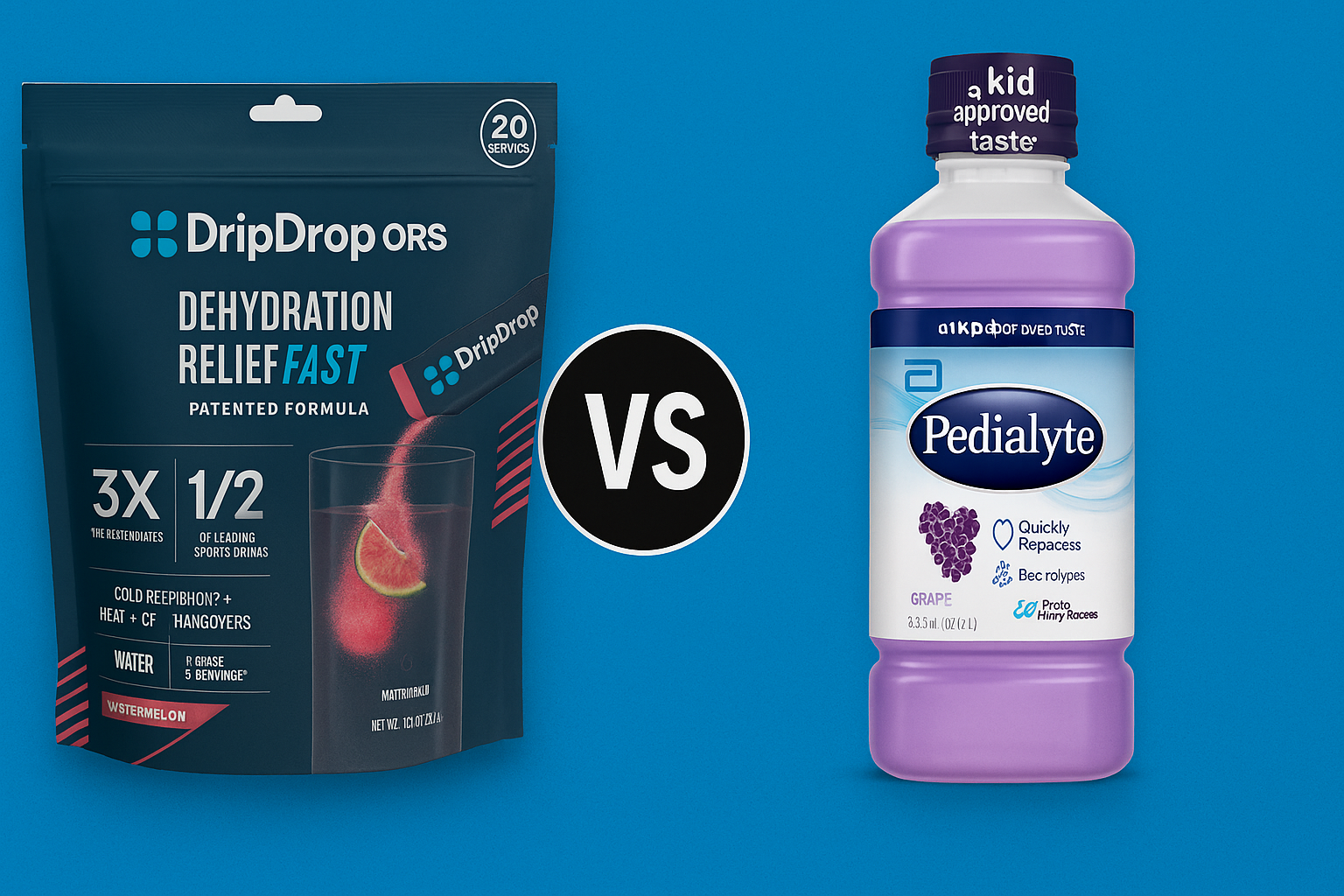
If you’ve ever battled dehydration from a workout, travel, or illness, chances are you’ve come across DripDrop and Pedialyte. Both claim to rehydrate you faster and more effectively than water, but they cater to slightly different needs. While Pedialyte has long been the go-to for electrolyte replacement during sickness or heat exhaustion, DripDrop was formulated by a doctor to offer medical-grade hydration with better taste and convenience.
So, which one should you trust when your body really needs electrolytes? Let’s dive into a detailed comparison of DripDrop vs. Pedialyte based on formulation, electrolyte content, sugar levels, taste, and real-world effectiveness.
What Is DripDrop?
DripDrop ORS is a single-serve oral rehydration powder designed to be mixed with 8 oz (237 mL) of water. It sits between medical ORS and sports drinks.
Primary goal:
Rapid rehydration when fluid and electrolyte losses are outpacing intake. Examples include:
- Heavy sweating or heat exposure
- Travel dehydration
- Mild GI losses
- Clear signs of dehydration
DripDrop is not meant to be an all-day flavored water. It intentionally includes sodium and carbohydrates to support absorption when you’re depleted.
Why DripDrop Works
ORS relies on glucose + sodium activating sodium–glucose cotransport (SGLT1) in the small intestine. When sodium is absorbed, water follows. This mechanism is well established in global health guidance for dehydration.
DripDrop ORS: Key Nutrition (Original Formula, 1 Stick)
- Sodium: 330 mg
- Potassium: 185 mg
- Magnesium: 39 mg
- Total carbs: 9 g
- Sugar: ~7 g
- Added nutrients: Vitamin C (70 mg), Zinc (1.5 mg)
The sugar isn’t just for taste. It’s there to make the hydration mechanism work.
Color & ingredients note:
DripDrop generally avoids FD&C dyes, using fruit and vegetable sources for color, but some flavors do include sucralose, so it’s not a minimalist ingredient profile.
What Is Pedialyte?
Pedialyte is a medical-style oral rehydration solution developed specifically for dehydration caused by vomiting and diarrhea, though it’s also used for heat and exercise dehydration.
Primary goal:
Prevent or treat mild-to-moderate dehydration, especially when fluid losses come from the GI tract.
Pedialyte closely follows ORS principles recommended by public health organizations and is often used in clinical and pediatric settings.
Why Pedialyte Works
Like DripDrop, Pedialyte uses glucose + sodium to improve fluid absorption versus plain water in true dehydration states. This is the same foundational science behind WHO-recommended ORS.
Pedialyte Electrolytes (Typical Ranges)
Pedialyte varies by product line, but common values include:
Classic (12 fl oz / 360 mL example):
- Sodium: ~390 mg
- Potassium: ~280 mg
- Chloride: ~440 mg
- Zinc: ~2.8 mg
Sport (per liter):
- Sodium: ~1,380 mg
- Sugar: ≤14 g
Sugar, Sweeteners, and Dyes
- Carb source is usually dextrose (glucose) to support ORS absorption.
- Sugar levels vary by line (Classic vs Sport).
- Some flavors include FD&C dyes (Red 40, Yellow 5, Blue 1).
- Unflavored Pedialyte typically contains no dyes.
If avoiding artificial colors matters to you, flavor choice matters.
DripDrop vs Pedialyte: Head-to-Head Comparison
| Feature | DripDrop ORS | Pedialyte |
|---|---|---|
| Product type | Single-serve ORS powder | Ready-to-drink ORS (also powders) |
| Primary purpose | Rapid rehydration from sweat, travel, mild GI loss | Medical-style rehydration for vomiting/diarrhea |
| Mixing volume | 8 oz (237 mL) per stick | Pre-mixed or varies by powder |
| Sodium (typical serving) | 330 mg per stick | ~390 mg per 12 oz (Classic) |
| Potassium | 185 mg | ~280 mg |
| Magnesium | 39 mg | Varies (higher in Sport) |
| Sugar / carbs | ~7 g sugar / 9 g carbs | Varies by line (Classic higher than Sport) |
| Carb role | Supports sodium–glucose transport | Supports sodium–glucose transport |
| Sweeteners | Sugar + additional carbs; some flavors include sucralose | Dextrose + sometimes sucralose/acesulfame-K |
| Artificial colors | Generally no FD&C dyes | Some flavors contain FD&C dyes |
| Best use case | Adult dehydration, heat, travel, sweating | GI illness, pediatric use, clinical dehydration |
| Casual sipping | ❌ Not intended | ❌ Not intended |
Which One Should You Choose?
Choose DripDrop If:
- You want a portable powder with a lighter ORS profile.
- Your dehydration is from heat, travel, or sweating, not severe GI illness.
- You prefer fewer artificial colors.
Choose Pedialyte If:
- Dehydration is from vomiting or diarrhea.
- You’re hydrating children or medically vulnerable adults.
- You want a solution that closely mirrors clinical ORS standards.
- You’re okay selecting specific flavors to avoid dyes.
Important Reality Check
Neither DripDrop nor Pedialyte is meant to be:
- A daily flavored water
- A sports drink replacement for fueling
- A zero-calorie hydration hack
They work best when you are actually dehydrated. If you’re already hydrated, the advantage over water is small.
Final Verdict
DripDrop and Pedialyte are built on the same hydration science, but they serve slightly different roles.
- DripDrop is a convenient, adult-friendly ORS that bridges everyday dehydration and medical hydration.
- Pedialyte is an ORS-first, beverage-second solution with deep roots in GI and pediatric dehydration care.