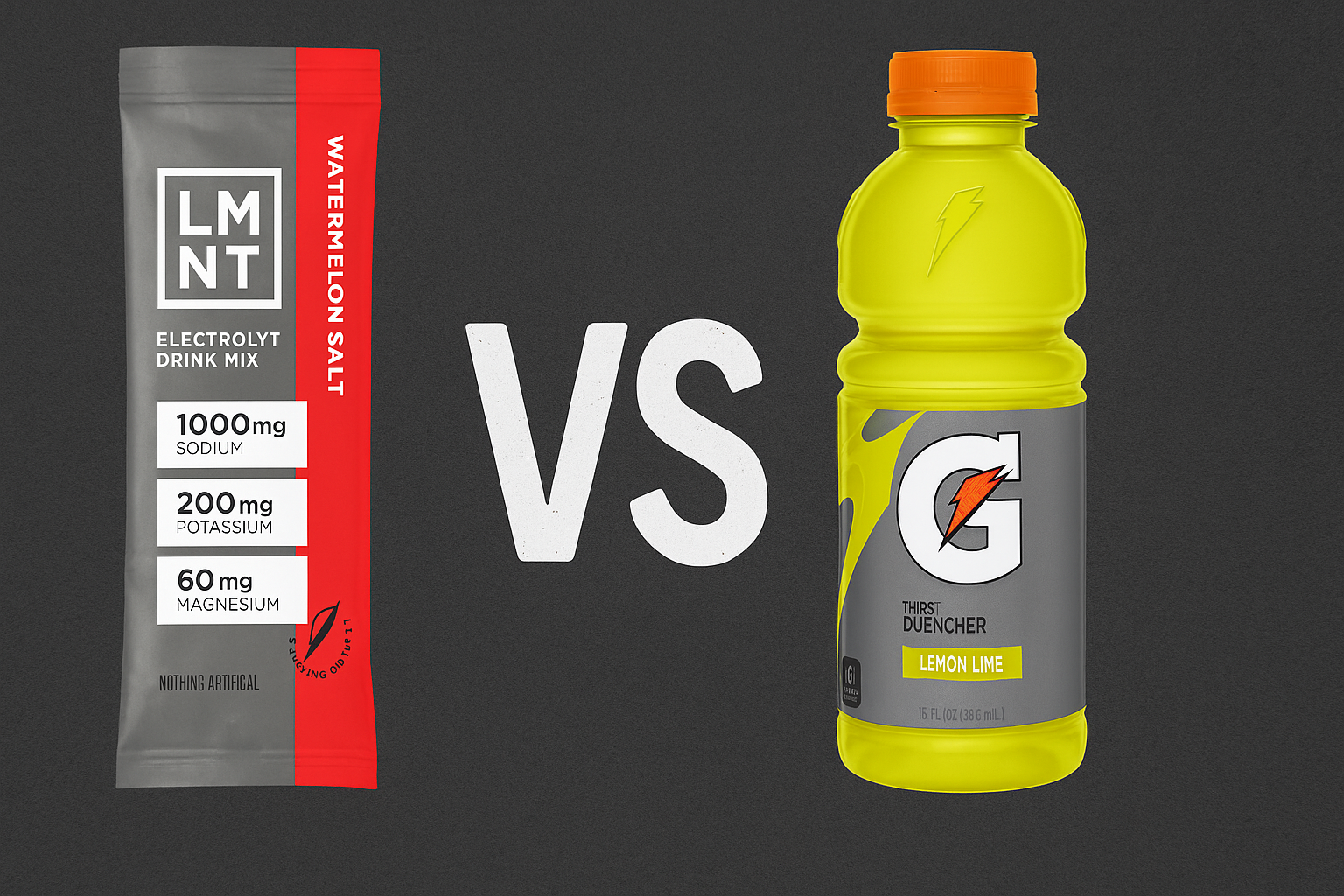
I’ve gone back and forth between LMNT and Gatorade more times than I can count. Gym days, long walks in the heat, travel days when I feel wiped out. I’ve reached for both, sometimes out of habit and sometimes out of desperation. They’re both marketed as hydration fixes, but my experience with each has been very different. So instead of repeating labels and marketing claims, I want to talk about what actually happened when I drank them, how they made me feel, and why I now choose one over the other depending on the situation.
What Is LMNT?

LMNT was created by Robb Wolf to fix a problem a lot of low-carb athletes run into: electrolyte depletion. If you cut carbs, sweat a lot, or train fasted, your body tends to burn through sodium and other electrolytes faster than you expect. That’s where LMNT comes in.
It’s built for people who:
- Sweat heavily
- Train fasted
- Follow keto, paleo, or low-carb diets
Each packet has a very specific electrolyte profile:
- Sodium: 1,000 mg
- Potassium: 200 mg
- Magnesium: 60 mg
You mix one packet with about 16 to 32 ounces of water, depending on how strong you like it or how much you’re sweating. There’s no sugar, no artificial colors, and no calories. That part surprised me the most at first, especially coming from years of drinking traditional sports drinks.
One important thing I had to wrap my head around: LMNT isn’t a sports drink. It’s not trying to fuel your workout or give you quick energy. It’s an electrolyte replacement tool. If you need carbs, calories, or fuel, you’re supposed to get that from food or something else. LMNT’s only job is to keep your electrolytes where they need to be, and it’s very intentional about staying in that lane.
What Is Gatorade?
Gatorade has been around forever, and there’s a reason for that. It was developed back in 1965 at the University of Florida for football players who were dealing with heat, long practices, and straight-up exhaustion. The goal wasn’t optimization or biohacking. It was simple: prevent dehydration, heat illness, and energy crashes.
A typical 12 oz serving looks like this:
- Sugar: 14 g
- Calories: 50
- Sodium: 160 mg
- Potassium: 45 mg
What Gatorade really leans on is carbohydrates. The sugar isn’t just there for taste. It helps improve fluid absorption and gives you quick energy in the form of glucose. That’s why it goes down so easily when you’re tired or overheated. Your body recognizes it as fuel.
From my experience, this is where Gatorade shines. It’s easy to drink, easy to find, and it feels immediately helpful when you’re doing something long, intense, or carb-burning. But it’s not built for high-dose electrolyte replacement. The sodium and potassium are relatively low compared to something like LMNT.
That’s the key difference. Gatorade is optimized for drinkability and energy delivery. It’s meant to keep you going, not to aggressively replace electrolytes you’ve burned through. Once I started paying attention to that distinction, it made a lot more sense why each one feels so different in real use.
Sugar Content & Energy Strategy
This is where the difference between LMNT and Gatorade really shows up in how they feel during training.
LMNT has:
- 0 g sugar
- 0 carbs
- 0 calories
Because of that, it keeps blood sugar stable. I don’t get spikes, crashes, or that sticky-sweet feeling in my mouth. This makes it ideal for:
- Fasted training
- Keto or low-carb athletes
- Anyone trying to avoid insulin spikes
When I drink LMNT on a fasted morning run, it doesn’t feel like I “broke” the fast. I stay clear-headed, steady, and hydrated without suddenly feeling hungry or jittery afterward.
Gatorade, on the other hand, has:
- 14 g of sugar per 12 oz
That sugar serves a real purpose. It helps prevent bonking during longer or harder sessions by providing quick glucose. I’ve found it useful when:
- Training goes past 60 to 90 minutes
- I don’t have solid food with me
- Intensity is high and steady
A simple example from my own training:
On a 90-minute bike ride, Gatorade can actually replace fuel. I feel more consistent energy, especially in the second half. But on a fasted morning run, that same sugar would defeat the whole point. That’s where LMNT works better. It keeps me hydrated without turning the session into a feeding window.
Neither approach is wrong. They’re just solving different problems. Once I stopped expecting one drink to do everything, choosing between them got a lot easier.
Sodium & Potassium Comparison
This is the part that really changed how I looked at these two.
LMNT is very upfront about what it delivers:
- Sodium: 1,000 mg
- Potassium: 200 mg
Gatorade, by comparison, looks like this per 12 oz serving:
- Sodium: 160 mg
- Potassium: 45 mg
On paper, that gap is huge. But the real difference hits when you do the math in a real-world scenario.
Let’s say you’re a heavy sweater. That’s me. In hot weather or hard sessions, it’s not unusual to lose around 1,500 mg of sodium per hour.
To replace that:
- I need about 1.5 packets of LMNT
- Or roughly 9 to 10 servings of Gatorade
That’s not a knock on Gatorade. It was never designed to replace sodium at that level. But if I’m relying on it for electrolytes alone, I’d have to drink a lot of volume and take in a lot of sugar to get there.
This is where LMNT starts to make more sense for me during hot, sweaty, or fasted training. I can hit my sodium needs quickly without overdrinking or accidentally turning hydration into a sugar load. Gatorade still has its place, but when sodium loss is the main problem, LMNT solves it way more efficiently.
Other Electrolytes
One thing I didn’t think about at all when I first started comparing these drinks was what wasn’t in them.
LMNT does include magnesium, which matters more than most people realize. Magnesium supports:
- Muscle contraction
- Nerve signaling
- Cramp reduction
That’s probably why LMNT feels different for me during longer or hotter sessions. I’m less twitchy, and I don’t get that tight, on-the-edge-of-cramping feeling as often.
Gatorade doesn’t contain magnesium at all. It focuses almost entirely on sodium, potassium, and carbs. Again, that’s intentional. It’s built for energy and drinkability, not electrolyte density.
That said, neither product offers full clinical electrolyte coverage. Both are missing:
- Calcium
- Chloride in meaningful doses
That’s an important distinction. LMNT improves electrolyte density, especially sodium and magnesium, but it’s still a partial profile. It’s not a “complete” electrolyte solution on its own. I’ve learned to think of it as a targeted tool, not a replacement for a well-rounded diet or proper meals.
Once I stopped expecting either drink to cover every electrolyte need, it was easier to use them for what they’re actually good at.
Taste & Palatability
This part is more subjective, but it matters more than most people admit.
Gatorade tastes exactly how you expect. It’s sweet, familiar, and easy to drink in large amounts without thinking about it. That’s a big reason it works so well for:
- Kids
- Team sports
- Long practices where you’re sipping constantly
I can hand Gatorade to almost anyone and know they’ll drink it. No adjustment period required.
LMNT is the opposite at first. The salt hits immediately. The first few times I tried it, I honestly wondered how people drank this stuff regularly. But something interesting happens. After about a week or two, your taste adapts. The salt stops feeling aggressive, and it starts tasting… right.
Once that adaptation happens, a lot of people, myself included, notice cravings. When I’m low on electrolytes, LMNT actually sounds good. That never happened with sweet drinks.
The big takeaway here is palatability controls intake. If something tastes good, you’ll drink more of it. If it doesn’t, you won’t, no matter how “optimal” it is on paper. That alone can decide whether a hydration strategy works or fails. Sometimes the best drink is simply the one you’ll actually finish.
Convenience & Availability
Gatorade is everywhere. Gas stations, gyms, schools, vending machines. You don’t have to plan ahead. You just grab a bottle and go. It’s also available as a powder, but the ready-to-drink bottles are what make it so convenient. When you’re tired, rushed, or already dehydrated, that matters.
LMNT is mostly an online purchase. You have to keep packets on hand, find water, mix it, and shake it. That’s fine when I’m prepared, but it’s not great in emergencies or spontaneous situations. If I’m already wiped and forgot to pack electrolytes, LMNT isn’t saving me that day.
This is one of those practical differences people gloss over. Convenience affects consistency. A less “perfect” option that’s always available often beats a better-formulated one that’s sitting at home in a drawer. That’s why, for me, Gatorade still earns a place as a backup option even though LMNT is what I use more deliberately.
Third-Party Testing & Transparency
This is one of those categories where the difference isn’t about performance, but trust.
LMNT is third-party tested for label accuracy and contaminants, and they publish those results publicly. I like that I don’t have to take their word for it. I can actually see what’s in the packet matches what’s on the label. That level of transparency feels intentional, especially for a product aimed at people who care about exact dosing.
Gatorade takes a different approach. It’s FDA-compliant, has been around for decades, and has a long safety record across millions of users. That carries real weight. At the same time, Gatorade doesn’t publicly share third-party batch testing results in the way LMNT does.
So it really comes down to transparency versus institutional trust. LMNT earns confidence by showing its work. Gatorade earns it by sheer scale, history, and regulatory oversight. Neither approach is inherently wrong, but depending on how much you care about seeing the data yourself, one will probably feel more reassuring than the other.
Price Comparison
This is usually where people stop listening, so it’s worth being clear.
LMNT costs about $1.30 to $1.50 per packet, depending on where you buy it. Subscriptions bring that down a bit, but it’s still not cheap on a per-serving basis.
Gatorade is much cheaper:
- Powder comes out to roughly $0.11 per serving
- Bottled Gatorade usually runs $1 to $2 each, depending on size and location
At face value, Gatorade clearly wins on price. But the cost only tells part of the story.
One LMNT packet delivers 1,000 mg of sodium. A standard Gatorade serving delivers about 160 mg. That means LMNT provides roughly six times the sodium per serving. If sodium replacement is your main goal, you’re not really comparing equal products.
So yes, LMNT costs more per serving. But you’re paying for electrolyte density, not volume or sugar. Gatorade is cheaper because it’s designed to be consumed in larger amounts and to deliver energy along the way. Once I started comparing cost per milligram of sodium instead of cost per drink, the pricing made a lot more sense.
Who Should Choose LMNT?
I reach for LMNT when electrolytes are the main problem I’m trying to solve, not energy.
It tends to make the most sense for:
- Heavy sweaters, especially if you see white salt residue on clothes or skin
- Keto or low-carb athletes who burn through sodium faster
- Intermittent fasters who want hydration without breaking a fast
- Endurance athletes who prefer to fuel separately with food or gels
- Anyone avoiding sugar and blood glucose spikes
If you know you lose a lot of salt and you don’t want sweetness in your drink, LMNT fits that niche really well.
Who Should Choose Gatorade?
Gatorade shines when simplicity matters.
It’s a better fit for:
- Youth athletes and team sports
- High-intensity workouts under 90 minutes
- Budget-focused users
- Anyone who wants hydration and energy in one step
- People who dislike salty-tasting drinks
Main Drawbacks (Specific)
Neither of these is perfect. The downsides matter, especially if you’re using them regularly.
LMNT Drawbacks
LMNT is very intentional with its formulation, but that comes with tradeoffs.
- 1,000 mg of sodium can be excessive if you’re sedentary or not sweating much. This isn’t something I’d sip casually all day.
- Premium pricing makes it harder to justify for everyday use if electrolytes aren’t a real need.
- Strong taste barrier turns a lot of people off before they ever adapt to it. If you hate salty drinks, this can be a dealbreaker.
LMNT works best when there’s a clear reason for that much sodium. Without one, it’s probably overkill.
Gatorade Drawbacks
Gatorade has its own set of issues, especially when used frequently.
- Sugar adds up fast. Multiple servings can easily hit 36 to 42 g of sugar, even without realizing it.
- Low electrolyte density means you often need several servings to replace meaningful sodium losses.
- Artificial colors and additives are still present in many versions.
- Plastic bottle waste becomes a real downside if you rely on ready-to-drink bottles.
Gatorade is convenient and familiar, but it’s easy to overconsume sugar when you’re really just trying to stay hydrated. Like everything else here, the drawbacks depend on how and how often you use it.
Final Verdict
After using both, this is the simplest way I can put it.
LMNT and Gatorade solve different physiological problems. They get lumped together because they’re both “hydration drinks,” but they’re built for different jobs.
- LMNT = electrolyte replacement
- Gatorade = hydration plus fuel
Problems start when you choose the wrong tool. Use Gatorade when you don’t need fuel, and you can end up with unnecessary sugar overload. Use LMNT when you actually need carbs, and you may under-fuel while still feeling flat.
The rule of thumb that’s worked best for me is simple:
- If I’m training hard and already eating carbs, LMNT makes more sense.
- If I need energy and hydration in one bottle, Gatorade is the better choice.