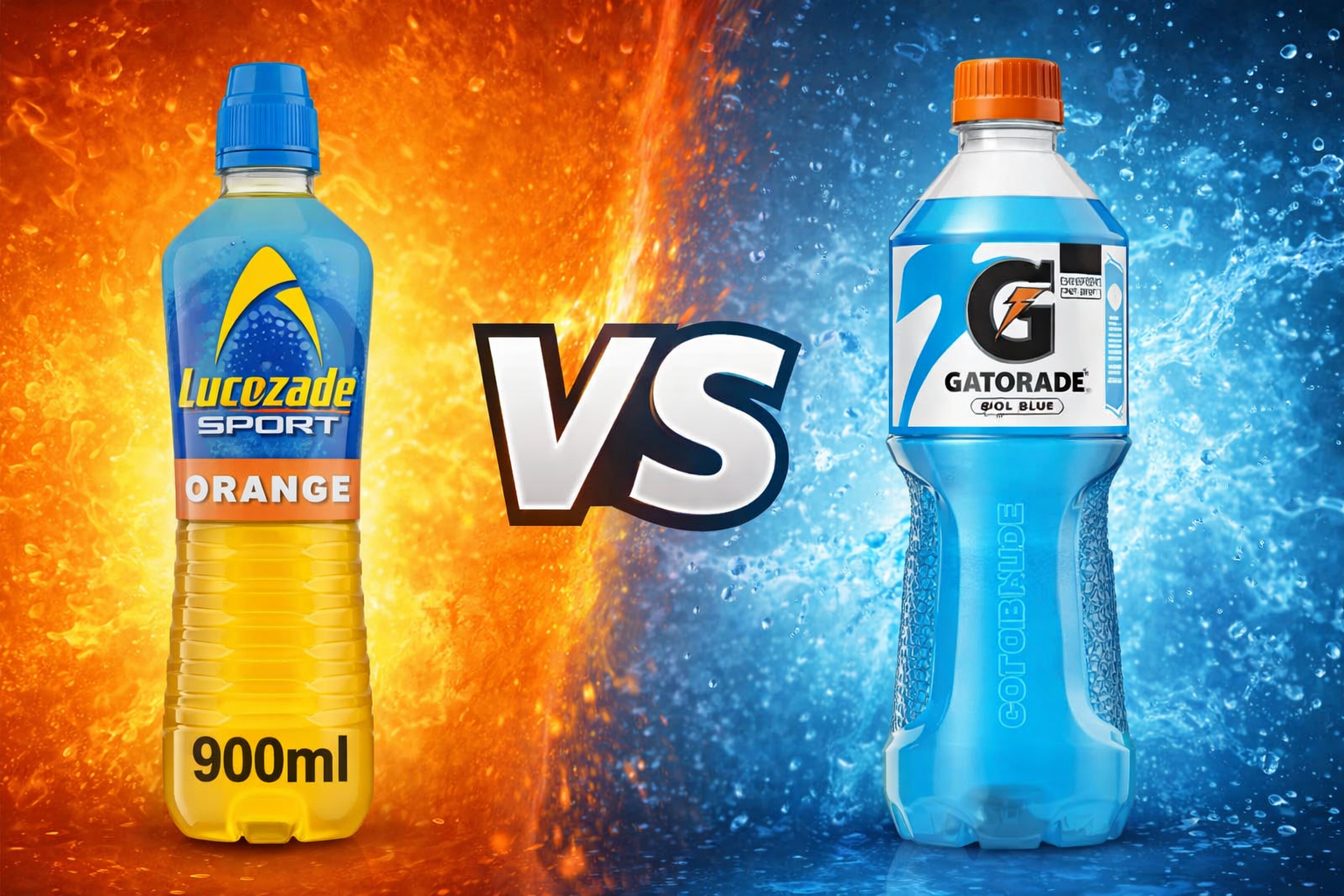
Lucozade vs Gatorade: Which One Actually Works Better?

I’ve reached for both Lucozade and Gatorade more times than I can count. Gym sessions, long walks, lazy afternoons when I just felt drained. At some point, I started wondering why I picked one over the other. Was it taste, habit, or did one actually work better for me?

That curiosity is what pushed me to really compare them. Not in a lab-coat way, but in a real-life, sweaty, slightly tired, everyday kind of way. I paid attention to how they tasted, how my body felt after drinking them, and when each one actually made sense for me to grab.

This isn’t about declaring a universal winner. It’s about my experience with both drinks, what I noticed, and when each one felt like the better choice. If you’ve ever stood in a shop staring at the fridge, debating between Lucozade and Gatorade, you’re exactly who I’m writing this for.

What Is Lucozade?

Lucozade has been around in the UK for a long time, and it didn’t actually start as a sports drink. It was first created way back in the 1920s as a glucose drink for people who were sick. Over time, the brand shifted gears. Now it’s positioned as a go-to drink for energy and sports, especially in the UK and Ireland. If you grew up here, chances are Lucozade was just always there. School trips, football matches, corner shops.

When I think of Lucozade Sport, though, I don’t really think “energy drink.” I think hydration. It’s clearly aimed at everyday exercise rather than elite athletes. The whole idea is lighter hydration with fewer calories, something you can sip during a workout without feeling like you’ve just downed a sugary soft drink. For me, it feels more like a middle ground. More purposeful than water, but not as heavy as some full-on sports drinks.

One thing worth mentioning is how much Lucozade has changed in recent years. After the UK sugar tax came in, the formula was reformulated to cut sugar levels. That’s why most Lucozade Sport drinks now use artificial sweeteners like sucralose and acesulfame K. You can taste the difference if you remember the older versions. Personally, I noticed it straight away. It’s lighter, less sticky-sweet, and easier for me to drink during longer sessions, though I know some people really miss the old sugar hit.

What Is Gatorade?

Gatorade feels like the heavyweight in the sports drink world. It started in the US back in the 1960s, created to help American football players deal with heat and intense training. That performance-first mindset still defines the brand today. Unlike Lucozade, which feels very UK-focused, Gatorade is everywhere. Elite sports, pro teams, big tournaments. It’s built its reputation on hydration science and high-level performance.

At the centre of everything is Gatorade Thirst Quencher, the classic isotonic formula most people think of when they hear the name. This is the version designed to replace fluids, electrolytes, and carbohydrates lost through sweat. When I drink it during or after a tough session, it feels more functional than refreshing. It’s clearly made to fuel work, not just quench thirst.

One thing Gatorade does better than almost anyone is range. There are several sub-lines depending on what you need:

  • Gatorade Zero cuts out the sugar but keeps electrolytes, aimed at hydration without the calories
  • G2 (lower-calorie) sits between Zero and the original, with reduced sugar
  • Endurance Formula is built for long, intense sessions, with higher electrolyte levels
  • Frost focuses on lighter, cooler-tasting flavours
  • Fierce goes the opposite way, with bolder, sweeter flavours that hit harder

Across all of these, the focus stays the same. Gatorade is about high-intensity sport, heavy sweating, and endurance. It’s the drink I reach for when I know I’m going to push hard or be active for a long time. It’s not subtle, and it’s not trying to be. It’s fuel, plain and simple.

Hydration Effectiveness

This is where I really started noticing a difference between the two, especially once my workouts went past the one-hour mark.

A big part of hydration isn’t just water. It’s sodium. Sodium helps your body hold onto the fluid you drink and also triggers thirst, which sounds minor but actually matters a lot when you’re sweating hard. Without enough sodium, you can drink plenty and still feel flat.

Both Lucozade Sport and Gatorade are isotonic, meaning their concentration is close to your body fluids. That makes them absorb faster than plain water. In my experience, that faster absorption shows up as steadier energy and less of that sloshy feeling you sometimes get from chugging water mid-workout.

Once exercise goes beyond about 60 minutes, both drinks clearly outperform water for me. I feel less drained, my endurance holds up better, and my perceived effort, what sports science calls RPE, stays lower. Basically, the same pace feels easier for longer.

Where they start to separate is intensity. Lucozade Sport feels lighter. Fewer calories, less sugar, and a more subtle hit. It’s great when I want hydration without feeling weighed down. Gatorade, on the other hand, feels more aggressive in a good way. More carbs, more electrolytes, and stronger support for maintaining plasma volume during heavy sweating. During long, high-intensity sessions, that extra fuel makes a noticeable difference.

It’s also worth saying that in extreme situations, like intense heat, dehydration from illness, or vomiting, neither of these is the gold standard. That’s where proper oral rehydration solutions (ORS) outperform sports drinks because they’re specifically formulated for medical-level fluid and electrolyte replacement.

🏆 Winner: Gatorade

For everyday workouts, both do the job better than water. But when sweat loss is high and sessions are long or brutal, Gatorade wins for me. The higher potassium and extra calories give it the edge for endurance and sustained high-intensity exercise.

Sodium Content

When it comes to electrolytes, sodium is the big one. It’s the primary mineral you lose through sweat, and it plays a huge role in fluid retention, nerve function, and muscle contraction. If sodium intake is too low during exercise, hydration just doesn’t work as well, no matter how much you drink.

Most sports nutrition guidelines point to roughly 50 mg of sodium per 100 ml as a sweet spot for effective hydration during exercise. That level helps replace sweat losses without tasting overly salty or upsetting your stomach.

Looking at the numbers, both drinks land right where they should.

  • Gatorade Thirst Quencher delivers about 48–54 mg of sodium per 100 ml, which works out to roughly 270 mg per 500 ml bottle
  • Lucozade Sport comes in at around 50 mg of sodium per 100 ml, or about 250 mg per 500 ml

In real-world use, I honestly can’t tell the difference between them when it comes to sodium support. Both keep thirst in check, both help prevent that washed-out feeling you get from plain water, and neither tastes aggressively salty.

🏆 Winner: Tie

Both Lucozade Sport and Gatorade sit squarely in the optimal isotonic sodium range. From a sodium perspective alone, they’re equally effective for exercise hydration.

Other Electrolytes (Potassium, Magnesium, Calcium)

After sodium, potassium is the electrolyte I pay the most attention to. It’s key for muscle contraction, nerve signalling, and keeping fluid balanced inside your cells. When potassium dips, that’s when cramps and heavy-leg feelings tend to creep in, at least for me.

In standard sports drinks, most electrolytes beyond sodium are usually present in smaller amounts. These are trace formulations, not full mineral replacements. That’s normal, but the differences still matter once intensity ramps up.

Potassium comparison (per ~500 ml)

  • Gatorade provides roughly 75–80 mg of potassium
  • Lucozade Sport comes in lower, at around 45 mg

I can feel that gap during harder sessions. Gatorade feels better at supporting muscle function when I’m sweating a lot or training for longer. Lucozade Sport still helps, but it’s clearly lighter and more hydration-focused rather than endurance-focused.

As for magnesium and calcium, both drinks only contain trace amounts in their standard versions. You’re not really drinking either of these expecting meaningful support for those minerals.

That said, both brands do offer more specialised options:

  • Lucozade FitWater includes added magnesium and calcium, aimed more at everyday hydration than performance
  • Gatorade Endurance Formula and Gatorlytes go much further, using a five-electrolyte blend designed for heavy sweating and prolonged effort

Those specialised versions are a different conversation altogether, but sticking to the standard formulas, the gap is clear.

🏆 Winner: Gatorade (Standard Formulas)

The higher potassium content gives Gatorade an edge for muscle function and endurance during intense or prolonged activity. Lucozade Sport stays lighter and simpler, which works for casual exercise, but Gatorade supports harder efforts better.

Ingredients

Both drinks are built around the same basic idea: an isotonic formulation. That means water, carbohydrates for energy, and electrolytes in concentrations your body can absorb quickly during exercise. Where they really differ is how they get there.

Lucozade Sport: lighter, more engineered

Lucozade Sport takes a more modern, lower-sugar approach. It uses glucose syrup for fast energy, but most of the sweetness now comes from artificial sweeteners, mainly aspartame and acesulfame K. That’s largely a result of the UK sugar tax reformulation.

It also includes added B vitamins like B3, B5, B6, and B12. These support energy metabolism rather than hydration directly, but I do notice Lucozade leans into the “energy support” angle more because of this.

On top of that, there are preservatives and stabilisers to keep the drink shelf-stable. Ingredient-wise, it’s clearly more complex, but that complexity is what keeps calories and sugar lower.

Gatorade: simple and old-school

Gatorade goes the opposite way. The sweetness comes purely from sucrose and dextrose, no artificial sweeteners at all. What you taste is what you get: carbs for fuel.

For electrolytes, it relies on compounds like sodium citrate and monopotassium phosphate, which help with fluid balance and muscle function. It does use artificial colours in many flavours, like Yellow 5, but there’s no vitamin fortification. Gatorade isn’t trying to be a multivitamin. It’s just fuel and hydration.

Personally, this makes Gatorade feel more straightforward. It’s higher sugar, yes, but also more predictable when I’m training hard.

🏆 Winner: Depends on preference

There’s no clear loser here.

  • Lucozade Sport wins if you want lower sugar, fewer calories, and added B vitamins
  • Gatorade wins if you prefer simple ingredients and carbohydrate-only sweetness with no artificial sweeteners

Sugar Content

Sugar is doing real work in sports drinks. It provides quick energy and also helps speed up fluid absorption in the gut. The trick is getting the amount right. Too little and performance can drop. Too much and the drink can become hypertonic, which actually slows gastric emptying and makes hydration worse, not better.

That’s why isotonic balance matters so much.

Looking at the numbers, the difference between the two is pretty clear.

  • Gatorade contains about 6 g of sugar per 100 ml, which works out to roughly 30–36 g per 500 ml bottle
  • Lucozade Sport sits much lower at around 3.5 g of sugar per 100 ml, or about 18 g per 500 ml

In practice, that means Gatorade delivers more energy per sip. That’s great for long or intense sessions, but it can feel like overkill for casual workouts. Lucozade Sport, on the other hand, keeps things lighter. I can drink it more freely without feeling like I’m stacking up calories I don’t really need.

It’s also worth calling out Lucozade Energy, the original version. That one is hypertonic, designed more as a quick energy hit than a hydration drink. Because of its high sugar content, it can slow fluid absorption during exercise, which is why I avoid it mid-workout and treat it more like a pick-me-up than a sports drink.

🏆 Winner: Lucozade Sport

For most everyday and moderate exercise, the lower sugar content makes Lucozade Sport easier to use for hydration without tipping into excess calories. Gatorade still has its place, but for regular training, Lucozade gets the edge here.

lavours

Flavours might sound like a small thing, but they matter. If I don’t enjoy the taste, I’m not drinking enough of it, no matter how good the formula is. This is where brand identity and sheer variety really start to separate Gatorade and Lucozade.

Gatorade goes big on choice. The global lineup is huge and constantly changing. You’ve got classics like Lemon-Lime, Cool Blue, and Fruit Punch, plus whole sub-ranges like Frost for lighter flavours, Fierce for bolder ones, Zero Sugar options, and even seasonal releases. Wherever you are in the world, there’s usually a Gatorade flavour that fits your mood and tolerance for sweetness.

Lucozade takes a different approach. There are fewer flavours overall, but the ones that exist are iconic, especially in the UK. Orange, Raspberry, and Caribbean Crush are instantly recognisable and tied closely to the brand’s identity. There’s also a clear split between flavour profiles in the Sport line versus the Energy line. Sport flavours are cleaner and lighter, while Energy flavours are sweeter and more intense.

For me, Lucozade feels familiar and nostalgic. Gatorade feels flexible. If I want to switch things up or avoid flavour fatigue during long training blocks, Gatorade makes that easier.

🏆 Winner: Gatorade

The sheer breadth of flavours, product lines, and sugar-free options gives Gatorade the edge. Lucozade’s flavours are iconic, but Gatorade simply offers more choice across more situations.

Overall Winner

After using both regularly, this is where I land.

Gatorade is the overall winner.

Not because Lucozade is bad. It isn’t. Lucozade Sport does exactly what it promises. Lighter hydration, fewer calories, easier to drink for casual workouts and everyday activity. If most of your sessions are under an hour or fairly moderate, Lucozade Sport honestly makes more sense.

But when I zoom out and look at the full picture, hydration effectiveness, electrolyte depth, energy delivery, flavour range, and performance under pressure, Gatorade just covers more ground.

It handles heavy sweating better.
It supports longer, harder sessions more reliably.
It offers more options depending on intensity, calories, and sugar tolerance.

If I had to pick one drink to rely on across training blocks, long sessions, hot days, and competitive effort, I’d reach for Gatorade without overthinking it.

Leave a Comment