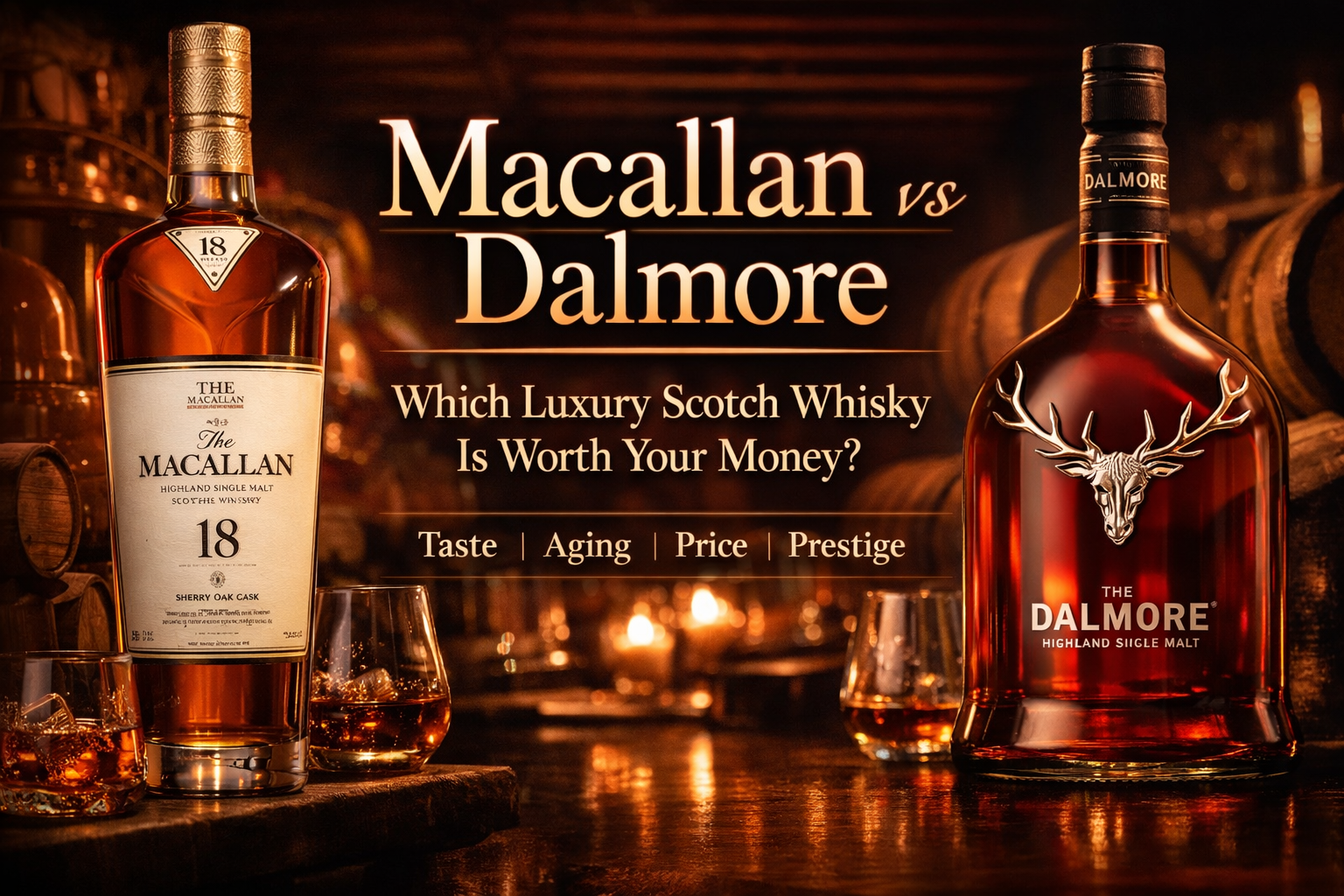
You’re standing in a premium liquor store, scanning a wall of amber bottles glowing under soft light. Two labels immediately command your attention. Both are beautifully crafted. Both radiate prestige. And both carry price tags that make you hesitate.
Welcome to one of the most debated matchups in the whisky world: Macallan vs Dalmore.
Is Macallan truly the gold standard of luxury Scotch — the bottle collectors chase and enthusiasts revere? Or does Dalmore offer deeper flavor, greater character, and stronger value for the price?
In this guide, we’ll unpack everything that actually influences your buying decision — from nuanced flavor differences many reviews overlook to maturation philosophy, collector appeal, pricing tiers, and the subtle psychology behind premium bottles.
Whether you’re a seasoned whisky drinker or preparing to purchase your first high-end single malt, by the end of this article you’ll know exactly which bottle deserves a permanent place on your shelf.
Meet the Legends: Brand Heritage and Prestige
In Scotch whisky, heritage is more than marketing — it’s a signal of mastery. A distillery’s history reflects decades (sometimes centuries) of refinement, experimentation, and craftsmanship.
Reputation shapes expectation. Expectation shapes experience.
Understanding the legacy behind each house explains why the Macallan vs Dalmore comparison carries such weight among enthusiasts.
The Macallan
Founded in 1824 in Scotland’s famed Speyside region, Macallan has built its reputation on an almost obsessive commitment to wood.
Few distilleries invest as heavily in cask quality — and fewer still control the process so meticulously. From oak selection to natural seasoning, every step is engineered to shape the whisky long before it begins aging.
Macallan is particularly renowned for its Oloroso sherry casks sourced from Spain. These barrels impart the rich dried-fruit sweetness and deep color that have become signatures of the brand.
Its positioning is unmistakable:
- Luxury craftsmanship
- Precision maturation
- Exceptional collector demand
Auction houses regularly feature Macallan bottles at record-breaking prices, reinforcing its reputation as both a drink and a financial asset.
Takeaway: Macallan represents heritage, discipline, and investment-grade prestige.
The Dalmore
Established in 1839 in the Scottish Highlands, Dalmore communicates a different kind of luxury — one that is immediately visible.
The iconic silver stag emblem isn’t subtle. It signals confidence, power, and presence before the bottle is even opened.
Where Macallan leans toward tradition, Dalmore embraces expression.
The distillery has become famous for finishing its whiskies in rare wine casks, including Port, Madeira, Marsala, and even Cabernet Sauvignon barrels. This approach introduces layers of flavor rarely found in more conservative maturation programs.
The result? Whiskies known for depth, drama, and indulgent richness.
Takeaway: Dalmore stands for creativity, layered complexity, and bold sensory impact.
Now that we’ve explored the heritage behind both houses, let’s move to the question buyers care about most:
What happens when the whisky hits the glass?
Flavor Showdown: Macallan vs Dalmore Taste Profile
The real Macallan vs Dalmore debate begins the moment the cork releases that soft, satisfying pop.
Macallan Flavor Profile
Macallan is often described with words like elegant, composed, and harmonious. Its heavy reliance on sherry-seasoned oak creates a flavor profile that feels deliberate rather than showy.
Expect notes of dried figs and raisins layered with orange peel, gentle baking spices, milk chocolate, and polished oak.
The texture is silky. The flavors arrive in waves rather than bursts. Nothing dominates; everything integrates.
If Macallan were music, it would be a classical symphony — structured, refined, and timeless.
Dalmore Flavor Profile
Dalmore, by contrast, enters with authority.
Its whiskies typically pour darker and feel fuller on the palate. Expect flavors of dark berries, treacle-like toffee, roasted coffee, cinnamon, nutmeg, and bittersweet chocolate.
The finish lingers — warm, slightly spicy, and unmistakably rich.
Where Macallan exercises restraint, Dalmore leans into intensity.
So which is smoother?
Technically, Macallan often wins on seamless integration. But smoothness isn’t always the goal. Many drinkers prefer Dalmore precisely because it makes a stronger impression.
Ultimately, the choice becomes philosophical:
Do you prefer elegance — or presence?
Aging & Cask Influence: The True Marker of Quality
New whisky drinkers frequently fixate on age statements. Experienced enthusiasts know better.
Cask quality shapes far more than the number on the label. It determines color, aroma, sweetness, mouthfeel, and complexity.
Macallan’s Philosophy
Macallan treats wood as an ingredient rather than a container.
By controlling oak sourcing, air-drying, and seasoning, the distillery ensures remarkable consistency across releases. That reliability is one reason collectors trust the brand so deeply.
Every sip reflects planning that began decades earlier.
Consistency, in this context, becomes a form of luxury.
Dalmore’s Philosophy
Dalmore takes a more adventurous path.
Many expressions mature in American oak before being transferred into rare wine barrels for finishing. These additional stages introduce fruit intensity, layered spice, and unexpected sweetness.
The outcome is personality. Variation. Memorability.
If Macallan feels architectural, Dalmore feels artistic.
Neither philosophy is superior — they simply appeal to different drinkers.
Price Comparison: Is Macallan Overpriced?
Now we arrive at the portion of the Macallan vs Dalmore conversation that quietly drives most purchasing decisions: value.
Luxury buyers don’t just want quality. They want justification.
Entry-Level Battle: Macallan 12 vs Dalmore 12
Both brands present strong contenders at the 12-year mark.
Macallan 12 offers textbook Speyside balance — polished, approachable, and endlessly reliable.
Dalmore 12 typically delivers richer chocolate-orange notes and a slightly more decadent mouthfeel.
For drinkers focused purely on sensory payoff, Dalmore often feels like the better value.
Mid-Range Luxury
This is where competition intensifies.
Macallan’s 15 and 18-year expressions carry immense prestige — and pricing that reflects it.
Dalmore answers with standout bottles like Cigar Malt Reserve and King Alexander III, celebrated for their layered sweetness and opulent character.
At similar price points, Dalmore can feel more indulgent. Yet Macallan’s global reputation continues to influence perceived worth.
Prestige, after all, has its own currency.
Collector Territory
Step into the ultra-premium tier and Macallan’s dominance becomes clear.
Its limited releases consistently command attention at auctions, supported by a long history of appreciation.
Dalmore produces exceptional rare editions as well, but its collector ecosystem remains smaller.
If you’re buying with investment in mind, Macallan is typically the safer play.
If your goal is unforgettable drinking experiences, Dalmore often delivers greater emotional return.
Design & Shelf Appeal: The Quiet Psychology of Luxury
Never underestimate the power of presentation.
Macallan bottles whisper sophistication through minimalist design and restrained labeling.
Dalmore bottles, crowned with the striking silver stag, are designed to be noticed.
When gifting, Dalmore often creates the bigger visual moment. On a curated bar cart, Macallan projects effortless refinement.
The better question may be this:
Which bottle feels more like you?
Macallan vs Dalmore: Quick Comparison
| Feature | Macallan | Dalmore |
|---|---|---|
| Region | Speyside | Highlands |
| Flavor Style | Elegant, balanced | Rich, expressive |
| Smoothness | Exceptionally integrated | Fuller-bodied |
| Price Perception | Prestige-driven | Value-forward luxury |
| Collector Appeal | Extremely strong | Growing but smaller |
| Ideal Drinker | Traditionalist | Flavor seeker |
Sometimes clarity fits best inside a table — and this one tells the story at a glance.
Best for Different Drinkers
Choose Macallan If:
- Heritage influences your buying decisions
- You gravitate toward refined, polished flavors
- Consistency matters
- Investment potential appeals to you
Choose Dalmore If:
- You enjoy bold, dessert-like richness
- You want a whisky that sparks conversation
- Experimental maturation excites you
- Flavor intensity outweighs brand prestige
This is the moment most readers recognize themselves.
Common Buyer Mistakes to Avoid
Even experienced whisky lovers stumble into these traps:
1. Chasing age instead of craftsmanship
Older doesn’t guarantee better.
2. Ignoring cask influence
Wood type can transform the entire experience.
3. Overvaluing “limited edition” labels
Scarcity alone doesn’t ensure appreciation.
4. Confusing investment bottles with drinking bottles
Buy for the purpose you actually intend.
The smartest buyers separate marketing narrative from personal enjoyment.
Expert Verdict: Which Whisky Wins?
Declaring a universal winner misses the point.
Instead, consider this your decision guide:
- For prestige and long-term value: Macallan
- For richness and flavor impact: Dalmore
- For unforgettable gifting: Dalmore
- For timeless smoothness: Macallan
The best whisky isn’t defined by auction results or critic scores.
It’s the one you anticipate pouring after a long day.
Final Pour: Macallan vs Dalmore
Both houses sit comfortably at the summit of luxury Scotch — yet they speak to different temperaments.
Macallan whispers sophistication.
Dalmore speaks with confident depth.
Choose Macallan if you admire heritage, collectibility, and quiet elegance.
Choose Dalmore if you crave richness, personality, and layered indulgence.
So now the decision rests with you:
Are you drawn to timeless elegance — or unforgettable richness?
Whichever path you choose, you’re entering a world where patience, oak, and craftsmanship converge into something extraordinary.
And that is always a choice worth savoring.