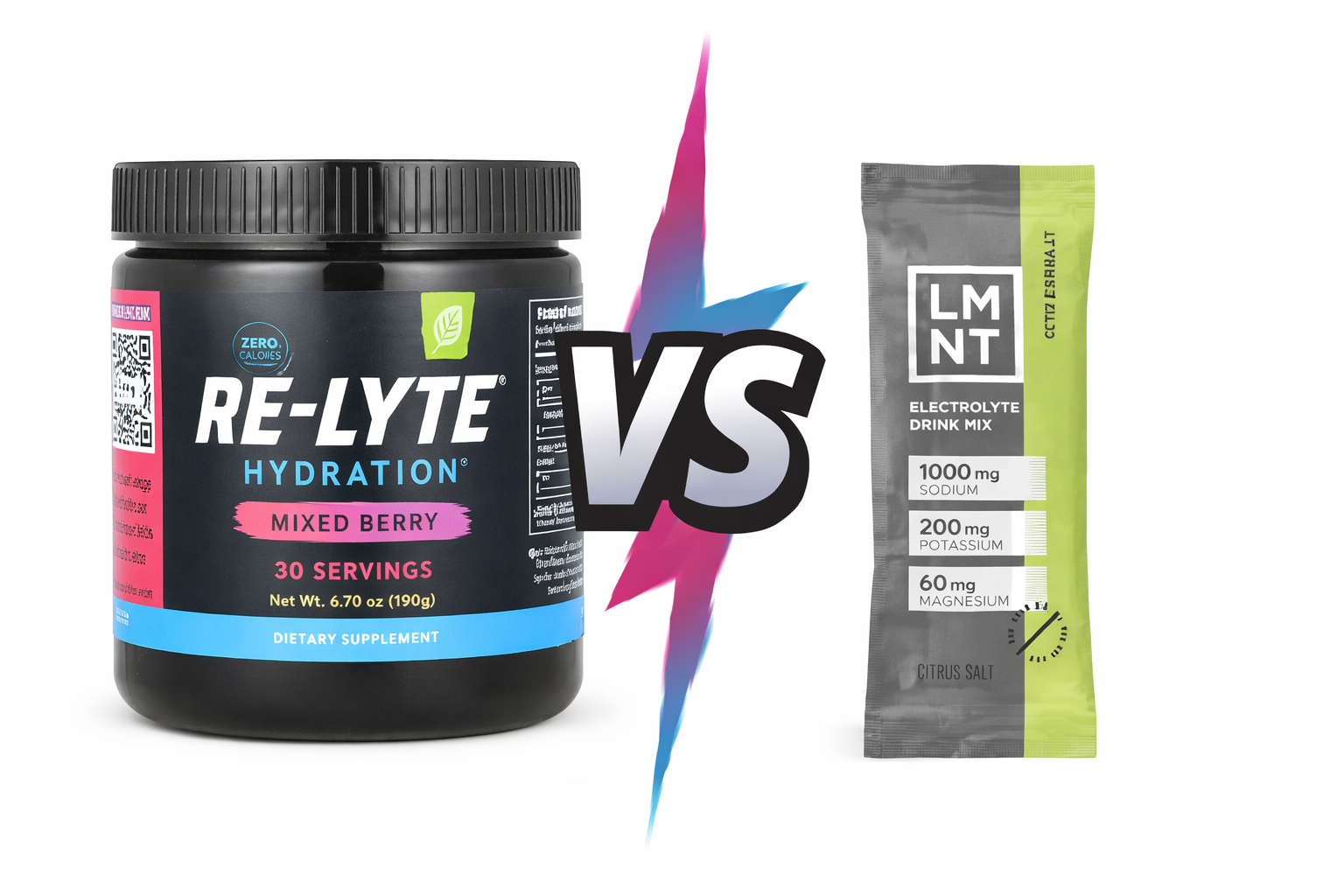
I didn’t plan on turning electrolyte powders into a whole experiment, but here we are. After a few rough workouts, some long days where water just wasn’t cutting it, and one too many headaches that felt suspiciously like dehydration, I decided to actually pay attention to what I was putting in my bottle. That’s how I ended up trying both Relyte and LMNT.
They’re two of the most talked-about electrolyte mixes out there, especially if you’re into fitness, fasting, keto, or just feeling human again after sweating a lot. I’ve used both enough times to notice real differences, not just in taste, but in how I felt during workouts and throughout the day. This isn’t a scientific breakdown or a sponsored pitch. It’s just my honest experience using Relyte vs LMNT and what stood out to me with each one.
What Is Re-Lyte?
Re-Lyte is a hydration powder made by Redmond Life, the same brand behind Redmond Real Salt. I first noticed it because of how heavily it leans into “clean” and minimal ingredients, which is usually what catches my eye when I’m looking for something I can use every day, not just after brutal workouts.
At its core, Re-Lyte is designed for daily hydration and light to moderate sweat replacement. Instead of loading everything up with intense sodium levels, it focuses more on balance. The formula uses Redmond Real Salt as its sodium source, plus coconut water powder and a blend of trace minerals. That whole-food angle is a big part of its appeal and honestly one of the main reasons I wanted to try it.
From how it’s marketed and how it actually feels when I use it, Re-Lyte isn’t trying to be an extreme performance electrolyte. It’s more for regular workouts, long walks, hot days, or times when plain water just doesn’t feel like enough. I’ve found it easy to drink casually throughout the day without feeling like I’m overdoing it on salt.
If you care about ingredient sourcing, trace minerals, and something that fits smoothly into everyday hydration, Re-Lyte clearly positions itself in that lane. It feels less like a “survival electrolyte” and more like a steady, daily support option.
What Is LMNT?
LMNT is an electrolyte drink mix built around one very clear idea: most people, especially active ones, aren’t getting enough sodium. The brand is LMNT, and it’s especially popular with heavy sweaters, endurance athletes, and people following ketogenic or low-carb diets.
The first thing I noticed when I looked at LMNT’s label was the sodium. It’s high. Like, intentionally high. Each packet is designed to deliver a strong hit of sodium alongside potassium and magnesium, with zero sugar and no fillers. That’s the whole pitch. No coconut water powder, no trace-mineral story, just what they consider a science-backed electrolyte ratio.
LMNT clearly isn’t aiming to be a casual, sip-all-day hydration drink. It’s positioned for harder workouts, longer training sessions, hot conditions, or situations where you’re losing a lot of salt. If you sweat heavily or eat low-carb and feel sluggish, crampy, or flat, LMNT is marketed as a way to correct that fast.
From my experience, LMNT feels more like a tool than a lifestyle drink. I reach for it when I know I’m going to need serious electrolyte replacement, not when I’m just trying to make my water taste better. It knows exactly who it’s for, and it doesn’t try to be everything to everyone.
Electrolyte amounts (exact numbers per packet)
This is the cleanest way to see how differently these two are built. When I put the packets side by side, the priorities are obvious.
Re-Lyte (per packet):
- Sodium: 810 mg
- Potassium: 400 mg
- Magnesium: 50 mg
- Calcium: 60 mg
LMNT (per packet):
- Sodium: 1,000 mg
- Potassium: 200 mg
- Magnesium: 60 mg
- Calcium: 0 mg
My takeaway:
LMNT clearly wins on sodium. If I’ve been sweating a lot, training hard, or eating low-carb, that extra salt can make a noticeable difference. Re-Lyte, on the other hand, spreads things out more. The higher potassium and added calcium make it feel like broader mineral support instead of just sodium replacement.
For me, LMNT feels more situational, while Re-Lyte feels easier to use regularly without feeling like I’m overloading on salt. Both work, they’re just solving different hydration problems.
Sugar content
Sugar isn’t a deciding factor for me with either of these, and that’s a good thing. I don’t want my hydration mix doubling as a sweetened sports drink, especially on low-carb days.
Re-Lyte has zero grams of added sugar. Some flavors do include coconut water powder, which can contribute trace, naturally occurring sugars, but it’s nothing meaningful from a carb or blood sugar standpoint. I’ve never felt a spike or crash from it, and it still fits easily into a low-carb routine.
LMNT is also completely sugar-free, no exceptions. That’s part of its core identity, and it stays consistent across flavors.
My takeaway is simple: sugar doesn’t separate these two at all. Both Re-Lyte and LMNT work perfectly fine for low-carb and keto diets, so the real decision comes down to electrolyte ratios and how much sodium you actually need.
Carbohydrate content
Carbs are another non-issue for me with both of these, which is refreshing if you’re used to traditional sports drinks. I don’t want sugar or fast carbs just to stay hydrated.
Re-Lyte comes in at around 0 grams of carbohydrates. Any trace carbs come from ingredients like coconut water powder, but the amount is so small it’s basically negligible in real-world use. I’ve never needed to count it or think twice about it.
LMNT is even more straightforward with 0 grams of carbohydrates across the board.
The takeaway here is that neither product relies on carbs to “drive” hydration the way drinks like Gatorade or Liquid I.V. do. If you’re avoiding carbs, fasting, or eating low-carb or keto, both Re-Lyte and LMNT fit easily without breaking anything.
Ingredients comparison
When I compare the ingredient lists side by side, the difference in philosophy is obvious. These two mixes are built with very different priorities in mind.
Re-Lyte uses Redmond Real Salt as its sodium source, which brings along trace minerals. It pairs that with potassium citrate, magnesium (malate or glycinate), and calcium lactate for a broader mineral profile. Some flavors also include coconut water powder, and sweetness comes from stevia leaf extract. Overall, the ingredient list feels more “whole-mineral” focused rather than just electrolyte replacement.
LMNT keeps things much tighter and more clinical. Its sodium comes from standard sodium chloride, paired with potassium chloride and magnesium malate. Citric acid and natural flavors are there for taste, but there’s no sugar and no carbs. Every ingredient feels chosen specifically to support high sodium intake and fast electrolyte replacement.
The takeaway for me is simple. Re-Lyte aims for a broader mineral blend built around real salt and trace minerals, while LMNT strips everything down to a minimal, sodium-dominant formula. One feels designed for everyday hydration, the other for deliberate, high-sodium use.
Hydration effectiveness
This is where personal context matters most, because hydration effectiveness depends heavily on how much you sweat and how much sodium you lose. I learned pretty quickly that the same electrolyte mix doesn’t work equally well in every situation.
LMNT’s 1,000 mg of sodium per packet makes a noticeable difference when I’m sweating hard or training for a long time. It helps me retain fluids faster, and I feel less flat or drained during long workouts or hot days. When I need rapid rehydration, LMNT does that job better than anything else I’ve tried.
Re-Lyte feels different. With lower sodium but higher potassium and the addition of calcium, it supports muscle function and overall mineral balance more gently. I’ve found it works well for daily hydration, shorter workouts, or days when I’m active but not completely wiped out. It doesn’t hit as hard, but it also doesn’t feel like overkill.
My takeaway is that LMNT shines for rapid, high-sodium rehydration, especially during heavy sweating. Re-Lyte works better for balanced, long-term hydration when I want steady support without pushing sodium too high.
Health and wellness benefits
When I look at these through a health and wellness lens, the benefits line up closely with how each formula is built.
Re-Lyte feels more supportive of everyday wellness. The higher potassium and added calcium help with muscle function, and the overall balance makes it easier to use daily without worrying about pushing sodium too high. On days when I’m active but not training hard, it supports hydration without feeling heavy or aggressive.
LMNT is much more performance-oriented. The high sodium content makes it especially helpful for endurance athletes or anyone who sweats a lot. I’ve also found it useful during keto or fasting periods, when sodium depletion can sneak up fast and leave you feeling sluggish or lightheaded.
The takeaway for me is that LMNT favors performance, endurance, and recovery under stress, while Re-Lyte leans toward overall mineral wellness and daily hydration support. Both have clear benefits, they’re just aimed at different needs.
Price comparison
Price matters more once you start using these regularly, not just as an occasional workout add-on. That’s where I started to notice a practical difference between the two.
Re-Lyte generally lands in the mid-range price per serving. For something I might drink daily or several times a week, it feels more reasonable. I don’t hesitate to use it on lighter activity days or even just to make sure I’m staying hydrated.
LMNT is typically more expensive per stick, and that makes sense given the branding and the very high sodium content per packet. I treat it more like a performance tool than an everyday drink, partly because of how it’s formulated and partly because of the cost.
The takeaway for me is that Re-Lyte is usually the more cost-effective option for daily hydration, while LMNT costs more but delivers performance-level sodium when you actually need it.
Flavor and taste
Taste was one of the first differences I noticed, and it lines up perfectly with how each product is formulated.
Re-Lyte has a milder, mineral-forward flavor. It’s less salty and easier to sip casually, especially if I’m drinking it throughout the day. Even the flavored versions don’t overpower the water, which makes it feel more like everyday hydration than a recovery drink.
LMNT, on the other hand, is very noticeably salty. There’s no mistaking what it’s meant for. If you expect your electrolyte drink to taste salty, LMNT delivers exactly that. During hard workouts or heavy sweating, the saltiness actually makes sense, but it’s not something I reach for just to sip casually.
My takeaway is that Re-Lyte tastes better for everyday use, while LMNT tastes better for people who want or expect a strong, salty electrolyte drink.
Customer experience
From what I’ve seen and from how I use them myself, the customer experience around each product matches the way they’re formulated.
Re-Lyte tends to attract people who are focused on daily hydration, a keto or low-carb lifestyle, and overall mineral wellness. It fits easily into casual workouts, walks, gym sessions, or just staying hydrated during a busy day. It feels like something you build into a routine rather than save for extreme situations.
LMNT’s audience is much more performance-driven. It’s popular with athletes, heavy sweaters, endurance trainers, and people who fast or train intensely. In those situations, hydration isn’t about sipping all day, it’s about replacing what you lose as efficiently as possible.
The takeaway for me is that Re-Lyte fits everyday hydration habits, while LMNT is better suited for high-performance or high-stress scenarios where electrolyte demands are much higher.
Which one should you choose?
If you’re deciding between these two, it really comes down to how you use electrolytes and what your body actually needs.
You’ll probably prefer Re-Lyte if you want a more balanced electrolyte profile and don’t feel great on very high sodium. It’s easier to use daily, tastes milder, and works well for regular workouts or general hydration. If flavor matters to you and you’re looking for something you can sip without thinking about it, Re-Lyte makes more sense.
LMNT is the better choice if you sweat heavily or consistently feel drained during long or intense workouts. The high sodium content is the whole point, and it shines when you need maximum salt replacement. If you train hard, do endurance work, fast regularly, or don’t mind a noticeably salty drink, LMNT does that job better than anything else here.
Final thoughts
After using both, I don’t see this as a true winner-takes-all comparison. Re-Lyte and LMNT are built for different situations, and once I stopped trying to force one to do the other’s job, they both made a lot more sense.
Re-Lyte is the one I reach for most days. It’s easier to drink, easier to use regularly, and supports hydration without pushing sodium too high. It feels like a long-term, everyday option that quietly does its job in the background.
LMNT is more of a problem-solver. When I’m sweating a lot, training hard, fasting, or feeling that unmistakable low-sodium drag, it works fast and decisively. I don’t need it every day, but when I do, nothing else really replaces it.
If you think about hydration in terms of context instead of brand loyalty, the choice becomes simple. Use Re-Lyte for balance and daily wellness. Use LMNT when performance and sodium replacement actually matter.