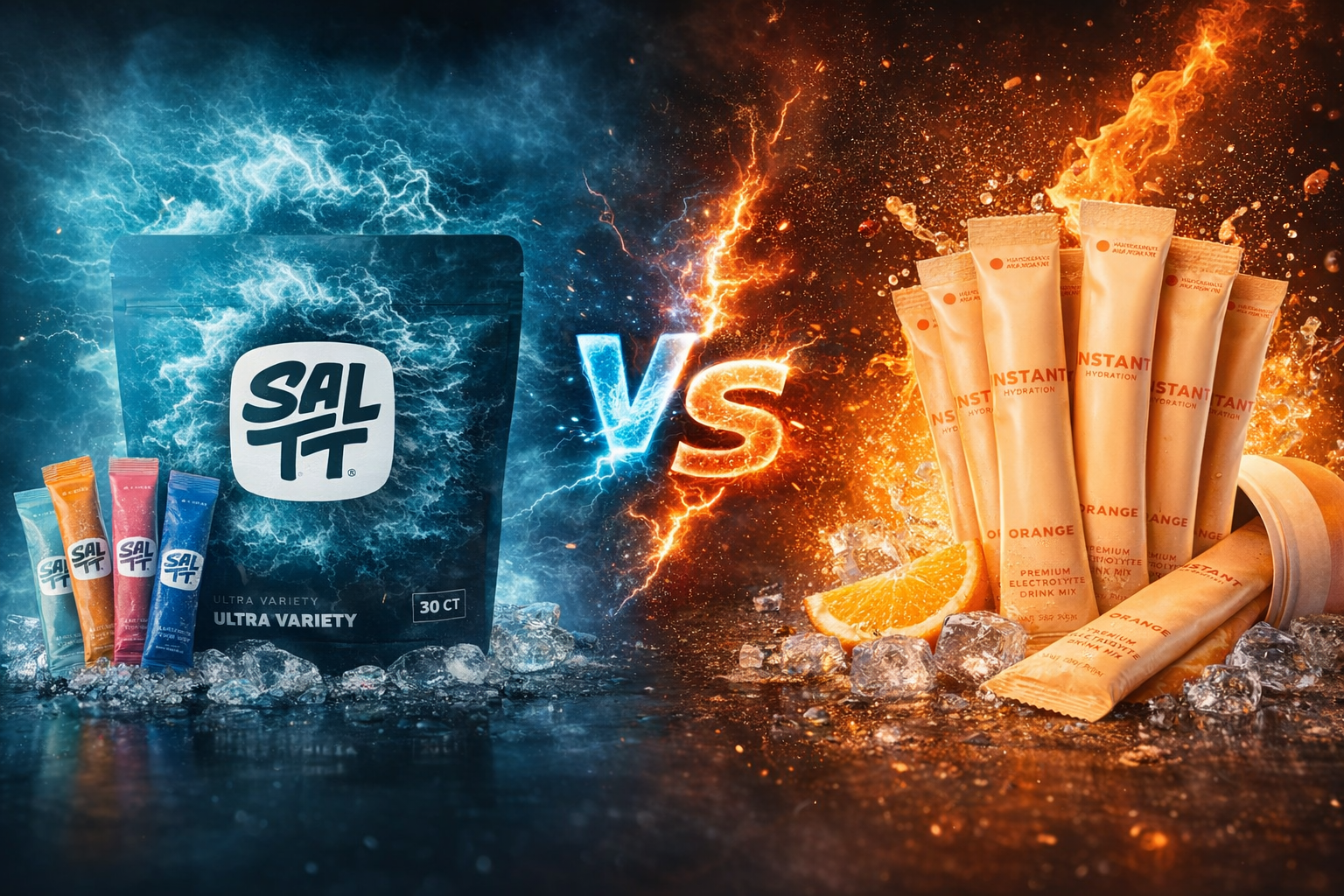
Electrolyte formulas start to look very different once you examine how they influence fluid movement across the intestinal wall and stabilize plasma osmolality under stress. SALTT and Instant Hydration represent two distinct formulation philosophies. One pushes sodium concentration to mirror sweat losses, while the other pairs sodium with glucose to improve absorption kinetics.
The contrast appears not just on the label but in how each behaves under specific physiological demands.
What Is SALTT?
SALTT is built on the premise that performance decline during prolonged exertion is often driven by sodium depletion rather than total fluid loss. To support this idea, the formula removes carbohydrates and nonessential additives so sodium levels can remain high without increasing serving size.
The product targets individuals with above-average sweat sodium losses — often athletes who notice salt residue on clothing or experience drops in blood pressure during long sessions. These users tend to benefit from electrolyte concentrations that more closely match sweat composition than traditional sports drinks provide.
One serving delivers sodium amounts that would typically require multiple servings of a standard electrolyte drink.
What Is Instant Hydration?
Instant Hydration follows a formulation model closer to oral rehydration therapy. Sodium is paired with glucose to activate SGLT1 transporters in the small intestine, a mechanism that moves sodium and water into circulation more efficiently than sodium alone, particularly during mild dehydration.
The formula is designed for situations where rapid uptake matters more than replacing large electrolyte deficits, such as long flights, moderate workouts, or recovery after illness.
Electrolyte ratios are tuned for palatability at higher drinking volumes, allowing a full serving to be consumed quickly without a strong saline taste.
Electrolyte Forms and Their Functional Impact
SALTT relies primarily on sodium chloride and potassium chloride, maximizing elemental mineral delivery per gram of powder. Chloride salts create a sharper taste profile but allow higher electrolyte loading with minimal supporting ingredients. Magnesium is typically included as citrate or malate to maintain solubility and reduce the risk of osmotic laxative effects associated with oxide forms.
Instant Hydration uses a higher proportion of citrate salts for sodium and potassium. Citrates buffer acidity and soften mineral sharpness, making the drink easier to consume at moderate concentrations. This buffering also slightly shifts solution pH, which can improve tolerance during rapid intake.
Salt form influences both taste perception and how quickly someone can comfortably finish a serving, indirectly affecting hydration speed.
Electrolyte Ratios Per Serving
SALTT typically provides:
- Sodium: 900–1000 mg
- Potassium: ~250 mg
- Magnesium: ~50 mg
This ratio strongly favors extracellular fluid replacement, aligning with sweat composition where sodium accounts for most electrolyte loss.
Instant Hydration typically contains:
- Sodium: ~500 mg
- Potassium: ~380 mg
- Magnesium: ~45 mg
The higher potassium proportion supports intracellular fluid balance, which can influence muscle excitability during moderate activity rather than prolonged endurance stress.
These ratios reflect different physiological priorities rather than a hierarchy of effectiveness.
Carbohydrate Inclusion and Osmotic Effects
SALTT contains no carbohydrates, leaving osmolality driven primarily by sodium concentration. This keeps caloric load low and avoids insulin response, which suits fasted training or ketogenic diets.
Instant Hydration includes roughly 10–11 g of glucose or cane sugar per serving. That amount falls within the range known to optimize sodium-glucose co-transport without pushing the solution into hypertonic territory. The carbohydrate increases osmotic pull across the intestinal wall, accelerating water uptake after fluid loss.
Carbohydrates therefore influence not only energy intake but also how quickly fluid enters circulation.
Sweetening Systems and Sensory Tradeoffs
SALTT uses stevia to maintain zero sugar content. Combined with high mineral concentration, stevia can produce a slightly bitter finish, especially at stronger concentrations, which may slow consumption for some users.
Instant Hydration uses real sugar, creating a fuller mouthfeel and masking mineral sharpness more effectively. This difference influences drinking speed, which directly affects fluid intake during short hydration windows.
Taste becomes a functional variable because faster consumption can improve hydration outcomes when time is limited.
Ingredient Architecture
SALTT keeps its ingredient list minimal — electrolytes, natural flavors, and stevia — reducing the likelihood of interactions with other supplements or sensitivity to stabilizers. The simplicity also allows users to add carbohydrates separately if needed.
Instant Hydration includes glucose and flavor stabilizers that improve batch consistency and prevent separation during storage. The slightly longer list reflects functional requirements rather than cosmetic additions.
Ingredient structure affects both shelf stability and flexibility in how the product can be used alongside other supplements.
Performance Under Heat and Sweat Stress
During prolonged exertion in hot conditions, sweat rates can exceed 1 liter per hour, with sodium losses ranging from 800–1200 mg per liter. SALTT’s sodium concentration closely matches those losses, helping maintain plasma osmolality and reduce drops in circulating volume that contribute to fatigue.
Lower-sodium formulas require multiple servings or added salt to reach the same replacement level, increasing total fluid volume required.
Matching intake to sweat composition explains why high-sodium formulas often feel more stabilizing during long sessions.
Performance During Mild Dehydration
When dehydration results mainly from fluid deficit rather than electrolyte depletion — such as long travel days — glucose-assisted transport becomes more relevant than sodium concentration alone. Instant Hydration’s sodium-glucose pairing accelerates absorption, allowing smaller volumes to restore hydration status more quickly.
High sodium without glucose may require more time or larger fluid intake to produce the same perceived effect in these scenarios.
This reflects how the body prioritizes transport efficiency versus electrolyte replacement depending on the stressor.
Neuromuscular Implications
High sodium intake during prolonged exertion supports nerve impulse transmission and muscle contraction by maintaining extracellular fluid balance. SALTT’s ratio aligns with preserving these gradients during extended sweat loss.
Higher potassium intake supports intracellular fluid balance and can influence muscle relaxation after contraction. Instant Hydration’s potassium proportion shifts support toward recovery and moderate activity rather than prolonged endurance strain.
These electrolyte balances influence neuromuscular function through separate mechanisms.
Flavor Behavior and Consumption Patterns
SALTT’s saline profile encourages slower sipping, which suits long training sessions where steady intake is preferred. Mineral intensity becomes more noticeable at higher concentrations, particularly in warm fluids.
Instant Hydration’s smoother flavor allows faster intake, which works well when hydration needs to happen quickly. Lower perceived saltiness also reduces palate fatigue across repeated servings.
Consumption speed often influences hydration outcomes more than flavor preference alone.
User Profiles That Align With SALTT
Athletes training in hot climates, individuals with high sweat sodium concentration, and those following low-carbohydrate fueling strategies benefit from higher sodium density. The formula also fits scenarios requiring electrolyte replacement without caloric intake, such as fasted endurance training.
Users who consume carbohydrates separately often prefer controlling electrolyte and energy dosing independently.
User Profiles That Align With Instant Hydration
People dealing with mild dehydration without significant electrolyte loss — including travelers and recreational exercisers — benefit from faster absorption and balanced electrolyte ratios. The formula also suits those who prefer a single product providing both hydration support and a small carbohydrate intake.
Short-duration activities where drinkability matters more than sodium density align well with this approach.
Key Formulation Differences That Drive Outcomes
- Sodium concentration is roughly double in SALTT, aligning with sweat replacement needs
- Instant Hydration includes glucose to activate intestinal co-transport mechanisms
- Potassium proportion is higher in Instant Hydration, shifting balance toward intracellular support
- SALTT minimizes ingredient complexity to reduce metabolic impact
- Instant Hydration prioritizes palatability to enable faster intake
Tradeoffs in Practical Use
SALTT achieves electrolyte replacement levels that standard drink mixes struggle to match but requires tolerance for a stronger saline profile and separate carbohydrate planning during long sessions.
Instant Hydration delivers faster perceived hydration in mild deficit scenarios but may not fully replace sodium losses during multi-hour endurance efforts without additional servings.
The distinction reflects density versus absorption efficiency rather than product quality.
Decision Framework Based on Physiological Context
Heavy sweating with visible salt loss or cramping points toward higher sodium intake per serving. Situations involving rapid rehydration after travel or mild fluid deficit favor sodium-glucose combinations that improve absorption speed.
Low-carbohydrate diets align more naturally with zero-sugar formulas, while mixed fueling strategies may benefit from integrated carbohydrate intake.
Matching electrolyte strategy to the dominant physiological stressor — electrolyte depletion versus fluid deficit — produces more consistent results than choosing based on flavor or brand familiarity.
Final Thoughts
Electrolyte formulas work best when they match the dominant stress your body is experiencing rather than trying to cover every scenario with one approach. High sodium density makes sense when sweat losses are measurable and sustained, especially in heat or long-duration efforts where plasma volume stability determines performance consistency.
Balanced sodium with glucose becomes more useful when fluid absorption speed determines how quickly you feel normal again, such as after travel, short illness, or moderate exertion where total electrolyte loss is smaller but rapid rehydration improves comfort and cognitive function.
A practical way to decide is to look at what usually triggers your fatigue or sluggishness. If it follows heavy sweating or long sessions, sodium density tends to solve the problem more directly. If it follows long days, dehydration, or inconsistent fluid intake, absorption-focused formulas typically feel more effective.
Electrolyte strategy becomes far more predictable once you match the formulation style to the physiological pattern you experience most often.