Trioral vs Liquid I.V.: Which Hydration Powder Works?
I’ll never forget the summer I spent three days in bed with food poisoning, cycling between crushing headaches and trips to the bathroom. My doctor handed me a packet of oral rehydration salts and said, “This will fix you faster than any sports drink.” She was right—but that chalky, medical-grade powder made me wonder: could something taste better and work just as well?
That question sent me down a rabbit hole comparing Trioral and Liquid I.V., two of the most popular hydration powders on the market. One follows a decades-old medical formula. The other dominates Instagram feeds with bright packaging and celebrity endorsements. But which one actually delivers on the promise of rapid rehydration?
The Sodium-Sugar Showdown
Here’s where things get interesting. Trioral follows the WHO’s reduced-osmolarity ORS formula to the letter: when you mix one packet with a liter of water, you get 75 mmol/L of sodium and 75 mmol/L of glucose. That works out to roughly 2,600 mg of sodium and 13.5 g of glucose per liter.
Liquid I.V., on the other hand, packs 500 mg of sodium and 11 g of sugar into each stick—but they recommend mixing it with just 16 ounces (about 500 mL) of water. Do the math, and you’re looking at a much sweeter, slightly less salty drink per liter: around 1,000 mg sodium and 22 g sugar if you scaled it up.
That difference matters. The WHO formula uses equal parts sodium and glucose because that’s the sweet spot for glucose-sodium cotransport—the mechanism that pulls water into your bloodstream most efficiently. Liquid I.V.’s higher sugar content makes it tastier, sure, but it’s not optimized for the medical-grade rehydration that comes with balanced ratios.
Why the WHO Formula Still Wins
The World Health Organization didn’t pull their ORS formula out of thin air. After decades of research and clinical trials, they settled on a reduced-osmolarity solution with a total osmolarity of 245 mOsm/L. Studies show this formulation reduces stool output by 20%, vomiting by 30%, and the need for IV fluids by 33% in children with acute diarrhea.
Trioral sticks to this gold standard. It’s the hydration powder your doctor would actually prescribe if you were dealing with gastroenteritis, heat exhaustion, or severe dehydration. It’s not trying to be trendy—it’s trying to keep you out of the emergency room.
Liquid I.V., meanwhile, markets itself for everyday use: post-workout recovery, hangovers, travel fatigue. It works fine for mild dehydration, but the formula wasn’t designed with medical-grade efficacy in mind. If you’re truly sick or dangerously dehydrated, Trioral is the one you want in your cabinet.
Flavor vs Function
Let’s be honest: Trioral tastes like you’re drinking a science experiment. It’s salty, slightly sweet, and vaguely citrus-flavored in a way that screams “I am medicine.” I’ve downed dozens of packets during stomach bugs and long runs, and I’ve never once thought, “Wow, refreshing!”
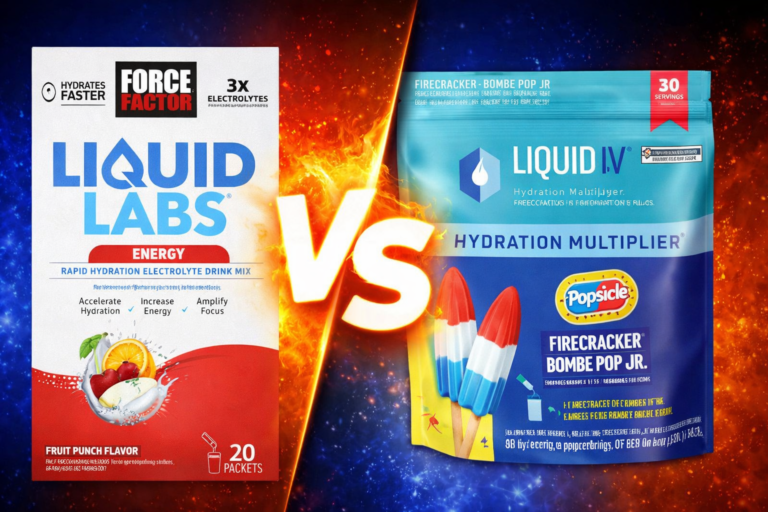
Liquid I.V., by contrast, comes in flavors like Passion Fruit, Watermelon, and Popsicle Firecracker. It tastes like a treat, not a treatment. If you’re someone who struggles to stay hydrated because plain water bores you, Liquid I.V. makes it easy to sip your way through a pack. The convenience factor is real, too—single-serve sticks are perfect for tossing in your gym bag or carry-on.
But here’s the trade-off: that extra sugar and those natural flavors bump up the calorie count (50 calories per stick) and the price. You’re paying for palatability, and depending on your needs, that might not be worth it.
How Osmolarity Affects Hydration Speed
Osmolarity is just a fancy way of measuring how concentrated a solution is. The WHO’s reduced-osmolarity ORS sits at 245 mOsm/L, which is slightly lower than your blood’s osmolarity (around 280-300 mOsm/L). That difference creates a gentle osmotic gradient, encouraging water to move from your gut into your bloodstream without overwhelming your system.
Standard sports drinks and older ORS formulas had osmolarities around 311 mOsm/L—higher than blood—which could actually slow absorption or even pull water into the gut, making diarrhea worse. Trioral’s lower osmolarity is why it works so well for illness-related dehydration.
Liquid I.V. doesn’t publish its osmolarity, but with that higher sugar content, it’s likely closer to the old-school range. That’s fine for everyday hydration, but it’s not the cutting-edge rehydration science Trioral offers.
How to Score These Powders on the Cheap
If you’re sold on Trioral, the best deals come from buying in bulk. A 100-pack of Trioral ORS packets runs around $40-$50 online, which works out to less than 50 cents per packet. Generic WHO-standard ORS packets (like Pedialyte powder or store-brand versions) can be even cheaper—just check the label to confirm they meet the 245 mOsm/L reduced-osmolarity formula.
For Liquid I.V., watch for sales at big-box retailers like Costco or Target, where you can sometimes snag multi-flavor packs for $20-$25 (around $1-$1.25 per stick instead of the usual $2-$3). Subscribe-and-save options on Amazon can knock another 5-15% off. If you’re not picky about flavors, clearance sections often have discontinued varieties at steep discounts.
Pro tip: If you’re using hydration powder regularly for workouts or travel, consider mixing your own. A DIY WHO-formula ORS costs pennies per liter—just combine 3/4 tsp salt, 6 tsp sugar, and a squeeze of lemon juice in a liter of water. It won’t taste like a Liquid I.V. flavor explosion, but your wallet will thank you.
The Final Verdict
Trioral is the no-nonsense workhorse. It’s what you reach for when you’re seriously sick, training hard in the heat, or dealing with anything that requires fast, effective rehydration. It’s cheap, it’s medically validated, and it works.
Liquid I.V. is the lifestyle upgrade. It’s what you sip on a Tuesday morning because hydration is self-care, or what you mix into your water bottle before yoga class. It tastes better, it’s more fun, and it’s perfectly fine for mild dehydration—but you’re paying a premium for convenience and flavor.
If I had to pick just one to keep in my pantry? Trioral, hands down. But I’d be lying if I said I didn’t keep a few Liquid I.V. sticks around for days when I need hydration to feel a little less like homework.